
There are filmmakers, then there are great filmmakers, and then there is Steven Spielberg, who exists in that increasingly rare category of artists whose work has become so embedded in our collective imagination that it feels less like cinema and more like familial memory. Even people who claim not to like Spielberg often discover, upon closer inspection, that half of their childhood was secretly directed by him.
For more than fifty years, Spielberg has been manufacturing wonder at an industrial scale. He convinced us that a giant shark could make an entire generation afraid of the ocean, that extraterrestrials could be both terrifying and lovable, that dinosaurs could walk among us again, and that museums were not merely buildings full of old things but battlegrounds for adventure. He made suburban childhood feel mythic, transformed history into spectacle without sacrificing humanity, and somehow managed to make a movie about Abraham Lincoln feel as suspenseful as a thriller. Long before artificial intelligence became the thing currently threatening to write everyone’s emails and movie scripts, Spielberg was already asking what it meant to be human in the face of technology with a young Hayley Joel Osment.
Yet despite a filmography that resembles a greatest-hits album for modern cinema itself, Spielberg’s name remains inextricably tied to the stars. Specifically, to aliens, and to the possibility that we are not alone.
From E.T. to Close Encounters of the Third Kind to his haunting adaptation of War of the Worlds, Spielberg has spent decades gazing upward and wondering what might be looking back. And for years now, audiences have quietly hoped he would return to that territory one more time. Not because Hollywood lacks alien movies. We all know there are approximately 17 released every Friday, but because nobody has ever made alien movies quite like Spielberg.
Now, at 79 years old, he has returned with Disclosure Day, which is a film whose title sounds less like a summer blockbuster and more like a government press conference gone horribly and yet wonderfully wrong. The surprise is that this isn’t the Spielberg alien movie anyone expects.
If E.T. was about friendship and Close Encounters was about obsession, then Disclosure Day feels like the work of a man who has spent nearly eight decades watching humanity alternate between breathtaking acts of kindness and astonishing feats of self-destruction. It is less interested in aliens than in us. It’s also less interested in first contact than in what kind of species is doing the contacting.
In an era where every blockbuster seems convinced that humanity deserves extinction, Spielberg remains one of the few filmmakers willing to argue the opposite. And thank God for that.
The film opens, delightfully and unexpectedly, with a professional wrestling match featuring two of my favorite wrestlers. It’s a sequence so joyous and bizarre that I briefly wondered if I had wandered into the wrong theater. Then the movie pivots. Suddenly, we’re dealing with a mysterious device of unknown origin, government agents chasing people across the country, and enough narrative uncertainty to leave some audience members checking whether they accidentally missed the first twenty minutes. That uncertainty is intentional. Spielberg wants us disoriented.
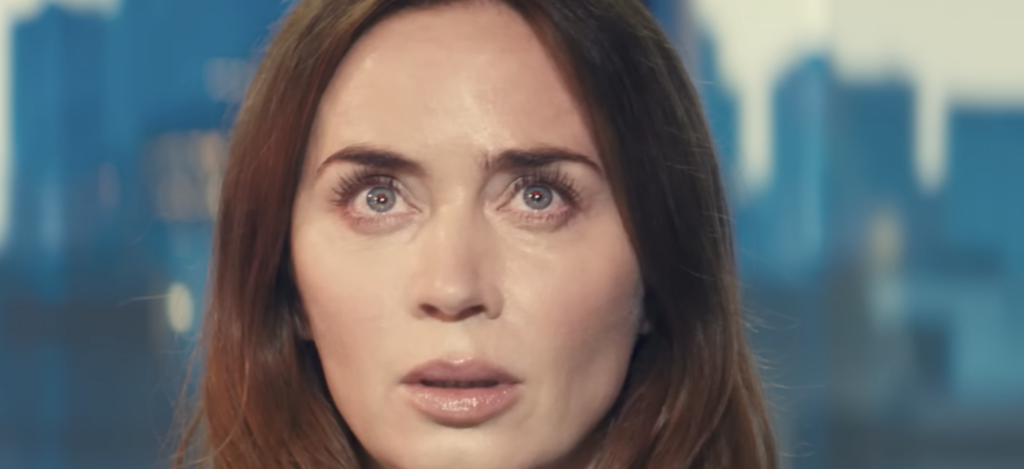
Soon, we meet Margaret, played by Emily Blunt, who is a Kansas City weather reporter whose life takes an unexpected turn after an encounter with a red cardinal that feels equal parts religious vision and cosmic prank. Following a strange episode, she discovers she possesses abilities she cannot explain.
Elsewhere, Daniel, played with weary determination by Josh O’Connor, is fleeing government forces after escaping with evidence of a decades-long cover-up involving extraterrestrial life. He, too, appears to possess abilities beyond normal human understanding.
What follows resembles a cat-and-mouse thriller wrapped inside a science-fiction mystery wrapped inside a philosophical meditation. Daniel and Margaret spend much of the film attempting to understand why these changes are happening to them and what role they play in a world that appears increasingly determined to destroy itself. Their search eventually leads them to Hugo, portrayed by Coleman Domingo with the kind of gravity that makes every line sound like it belongs in scripture.
Meanwhile, the planet inches toward geopolitical catastrophe. The remarkable thing about Disclosure Day is what Spielberg chooses not to do.
There are no grand Independence Day-style battles. There are no extended sequences of aliens stomping around landmarks. And there are no scenes of world leaders awkwardly shaking tentacles or giving speeches. The film repeatedly sidesteps the conventions audiences have been trained to expect. Instead, Spielberg turns inward.
The extraterrestrial presence hangs over the movie like a question rather than an answer. What matters is not whether aliens exist. The question is what matters is how humanity behaves when confronted with the possibility that it is part of something larger than itself.
The film circles themes that have occupied Spielberg for decades but now feel richer, more complicated, and more urgent. Empathy, compassion, faith, mortality, and the uncomfortable possibility that our greatest strength as a species may not be intelligence but understanding. At 79, Spielberg appears less interested in explaining the universe than in asking whether we deserve to participate in it. That’s a much more interesting question.
And while the film is largely contemplative, Spielberg still possesses an almost supernatural command of cinematic suspense. There is a major action sequence midway through the film that left me grinning like a child. The scene is orchestrated with such precision and clarity that it serves as a reminder of something younger filmmakers sometimes forget. Spielberg didn’t invent modern blockbuster language, but he certainly wrote most of its grammar. Watching it, I had the same thought I imagine basketball fans have when they watch an aging superstar sink a game-winning shot. I thought, “Oh, right. He can still do that perfectly.”
Then there’s Emily Blunt, who delivers what may be one of the finest performances of her career. She moves through the film with astonishing emotional dexterity, shifting between vulnerability, fear, humor, wonder, grief, and determination, sometimes within the same scene. Her performance anchors the film’s larger ideas, ensuring they remain human rather than abstract. Without her, Disclosure Day might simply be an intriguing thought experiment. With her, it becomes deeply moving.
I suspect the film will divide audiences. Spielberg concludes the story with a significant cliffhanger, which is one that will undoubtedly frustrate viewers who prefer their endings neatly packaged and tied with a bow. Yet it feels exactly right. The ending doesn’t close a door so much as leave it open. Whether a sequel ever materializes almost seems beside the point.
The true achievement of Disclosure Day is something much rarer than narrative closure. It sends you home feeling better about people. Not because humanity suddenly becomes perfect, and not because the world stops being frightening. But because Spielberg still believes that empathy matters. He believes that compassion matters and that understanding matters.
Those ideas may sound quaint in 2026, which is precisely why they feel revolutionary. We live in an age addicted to cynicism. Catastrophe has become our default setting. Every day seems to arrive carrying fresh evidence that we’ve learned absolutely nothing from the previous one. And then comes Spielberg, nearly eighty years old, still looking at the stars and somehow finding reasons to believe in us. That may be the most science-fiction element of Disclosure Day. It’s also what makes it one of the year’s most necessary films.







One Response
Wasn’t planning on watching this movie- not typically my genre! However- now- I can’t wait to experience it!