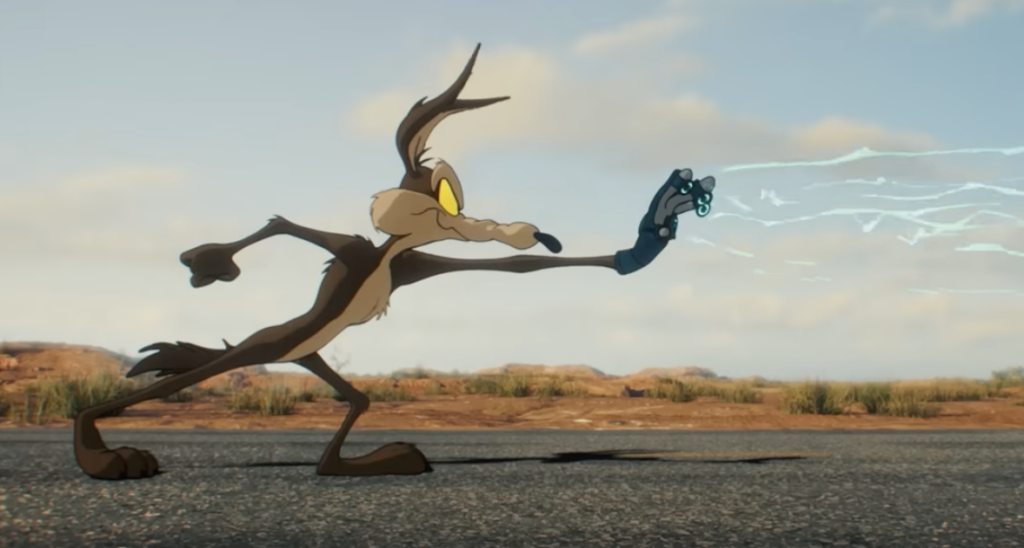
Some movies are made and released. There are also some movies that disappear without ever having a proper release, and into obscurity. And then there is Coyote vs. Acme, which seems to have experienced all four stages of Hollywood existence while refusing to die. This is the film that was never supposed to be. It’s a movie that endured corporate purgatory, tax-write-off hell, public outrage, and the peculiar indignity of being treated like an accountant’s problem rather than a piece of art. And yet, somehow, here it is.
It’s alive. Like Frankenstein, it’s actually alive. I can’t believe it. Coyote vs. Acme is a film that went through torture, multiple deaths, and what can only be described as a Looney Tunes-level resurrection. It has risen from the ashes like a phoenix, except the phoenix is being chased by a Road Runner while a giant anvil falls from the sky. And honestly, that feels appropriate. Before getting into the movie itself and why I think it’s terrific, you really need to understand what this thing went through to get here.
The film was conceived back in 2018, at a time when Hollywood had apparently decided that audiences wanted to spend their evenings contemplating the collapse of civilization, marriage, capitalism, superheroes, and the human soul. We had 1917, Uncut Gems, Avengers: Endgame, Once Upon a Time in Hollywood, Parasite, and A Marriage Story. We were watching people suffer beautifully in 4K. Perhaps we simply weren’t ready for Wile E. Coyote to sue a corporation. Fair enough.
But by 2022, the film had been made. It had Will Forte. It had John Cena. It had Looney Tunes characters. It had a reported budget north of $70 million, and it had undergone test screenings that, according to the extraordinary story surrounding the movie, produced an almost absurdly positive response. And then Warner Bros. shelved it. Just like that. It was gone into the vault, never to be seen again.
The reasons surrounding the decision became a source of enormous public controversy, particularly because the film was reportedly being treated as a tax write-off. The notion that an expensive, completed movie could simply be erased from existence for corporate accounting purposes struck a nerve with audiences and filmmakers alike. Hollywood has always had a complicated relationship with art, but there was something uniquely depressing about spending tens of millions of dollars making a movie and then deciding the best place for it was somewhere near the back of the filing cabinet. The backlash was enormous.
And suddenly Coyote vs. Acme became something more than a movie. It became a symbol of what happens when the people who make art and the people who monetize it discover that they are, in fact, different species. Eventually, a bidding war emerged, and Ketchup Entertainment acquired the rights to release and distribute the film. Which means that the movie that is literally about a giant corporation screwing over the little guy became a movie that was itself nearly destroyed by a giant corporation before being rescued by someone else. You couldn’t write this irony. Well, apparently you could.
Because behind all of this corporate chaos is a genuinely talented group of filmmakers. Director Dave Green, who previously gave us Earth to Echo and the live-action Teenage Mutant Ninja Turtles sequel, is at the helm. Samy Burch wrote the screenplay, following her Oscar-nominated work on the pedophile drama May December. And James Gunn is among the producers, alongside Chris DeFaria, whose producing résumé includes Mad Max: Fury Road. What a strange, wonderful group of people to throw into a room and say, “Okay, make a movie about a coyote suing a company that manufactures everything.”
And somehow, they did. More importantly, they made a really good one. Coyote vs. Acme is enormous fun. It brings the Looney Tunes into a new era without sanding off everything that made them special in the first place. It understands nostalgia without becoming a hostage to it. And perhaps most importantly, it doesn’t seem particularly interested in treating children like idiots. This isn’t a movie that exists merely to throw brightly colored objects at a six-year-old until the closing credits arrive. It feels much more in the spirit of Who Framed Roger Rabbit, which is another movie that understood that animation could be funny for children while simultaneously giving adults something considerably more interesting to chew on.
There are jokes here. Lots of them. But the jokes have purpose. The movie is essentially a legal thriller disguised as a Looney Tunes movie, which may be the most ridiculous sentence I have ever written, and also one of the reasons it works so well. Wile E. Coyote has spent his entire existence trying to catch the Road Runner. For decades, he has demonstrated that he is perhaps the most intelligent creature in the desert and simultaneously the least successful predator in human history. He engineers elaborate machines. He studies physics. He builds traps. And he purchases products from Acme with the confidence of a man who has somehow never read a single customer review.
And every single time, the product betrays him. He gets blown up, flattened, electrocuted, crushed, and generally abused by the laws of physics. At some point, you have to wonder whether the Road Runner is even the problem anymore. So Wile E. finally decides he’s had enough. Enter Kevin Avery, played by Will Forte, a small-time lawyer who represents Toons but has never actually won a case. Kevin has built an entire career around settling cases for a few hundred dollars and walking away. He doesn’t lose because he never really tries to win. Then Coyote walks into his life. And together they decide to sue Acme. Naturally.
Acme, in this universe, is essentially Apple if Apple were run by a gigantic rooster and had absolutely no concern whatsoever about the structural integrity of its products. That rooster is Foghorn Leghorn, who functions as the embodiment of every smug corporate executive who has ever said, “We take these allegations very seriously,” immediately before deleting an email.
Opposing Kevin is Buddy Crane, played by John Cena, a ruthless corporate attorney who treats litigation less like justice and more like a contact sport. Cena, of course, is invisible to us whenever he wants to be, but here he is very much visible and chewing through the scenery like it owes him money. Forte, meanwhile, brings something surprisingly tender to the movie. His Kevin is funny, but he is also bruised. He’s a guy who has convinced himself that settling is safer than trying. It’s easier not to fail if you never really attempt anything.
And then there’s Wile E. Coyote. The beautiful thing about the character here is that he finally gets to become something other than the punch line. For generations, we have watched this poor bastard get obliterated by his own inventions. We knew him as the guy who always failed. But Coyote vs. Acme asks a more interesting question. What if he’s not a failure? What if he’s just been fighting the wrong battle? The film finds an unexpected emotional center in the relationship between Kevin and Coyote. There’s a scene in which the two have a genuine heart-to-heart, and Coyote’s animated emotions somehow become our own. That caught me off guard.
I have spent most of my life watching Wile E. Coyote get hit in the face with a piano. I was not prepared to feel something about him. And yet, here we are. That’s where the movie becomes more than a nostalgic exercise. Beneath all the jokes and elaborate destruction is a story about friendship, loyalty, perseverance, and the terrifying act of believing in yourself after life has given you plenty of reasons not to. It’s also a pretty pointed David-and-Goliath story about corporations, power, money, and what happens when the little guy decides that being little doesn’t mean being powerless. Which is particularly funny considering the movie itself nearly became a casualty of exactly the kind of corporate machinery it is criticizing. There’s something wonderfully poetic about that.
The film’s live-action and animation blend is excellent. The Looney Tunes characters actually feel as though they belong in this world rather than being digitally pasted into it. When Bugs, Daffy, Porky, Foghorn, and the rest appear, it feels less like a desperate nostalgia parade and more like welcoming old friends back into the room. And the action is surprisingly fantastic. There’s a car chase that has a distinctly Mad Max: Fury Road flavor to it, which makes sense considering Chris DeFaria’s involvement. Watching a Road Runner-adjacent universe collide with that kind of kinetic filmmaking is exactly as glorious and insane as you might imagine.
Then there’s Forte, who gets to show off the dramatic chops we occasionally glimpse beneath all that manic comedy. His performance has a sincerity to it that reminded me of Nebraska. He’s funny without constantly insisting that he’s being funny. Cena, meanwhile, is having the time of his life. He is a magnificent bastard. And it works. The greatest surprise of Coyote vs. Acme is that it has a heart. Not the manufactured kind studios occasionally inject into animated movies like an emotional preservative, but an actual beating heart. The movie understands that nostalgia isn’t simply remembering what you loved as a child. Sometimes it’s discovering that the thing you loved as a child has grown up with you. That’s what makes this movie work.
It’s funny, smart, visually inventive, nostalgic without being suffocating, and it actually has something to say. In an era when Hollywood seems increasingly obsessed with turning every recognizable property into another piece of intellectual property to be monetized until the corpse stops twitching, Coyote vs. Acme feels almost rebellious. It is a movie about characters who refuse to give up that was made by filmmakers who refused to give up on the movie, that was released by a company that refused to let the movie disappear, and watched by an audience that, apparently, refused to let Wile E. Coyote die one more time.
After everything this movie has been through, I almost feel obligated to recommend it. But I don’t have to. I genuinely loved it. And I want more of this. I want more Looney Tunes movies with actual stories and more animation blended intelligently with live action. I also want more films that trust audiences to be both nostalgic and intelligent, and more movies that can make you laugh at a gigantic anvil falling on someone and then, five minutes later, make you unexpectedly emotional about why that person keeps getting back up. Because maybe that’s the real story of Coyote vs. Acme. It isn’t about a coyote who can’t catch a bird. It’s about a guy who keeps getting knocked down and decides that this time, he’s going to stand up. And after everything this movie has endured, there is something almost impossibly satisfying about watching it do exactly that.
Coyote vs. Acme was supposed to be dead. Instead, it beep-beeped its way back from the grave. And I’d happily watch it another hundred times.