For more than twenty years, Kill Bill has existed in the peculiar state of being both a movie and an argument. Quentin Tarantino’s fourth feature was originally conceived as one enormous, blood-soaked epic, before the studio, apparently doing the sort of arithmetic studios do, decided that one movie could become two movies and, therefore, two opportunities to take your money. They were right. Capitalism, like a samurai sword, is difficult to stop once it starts swinging.
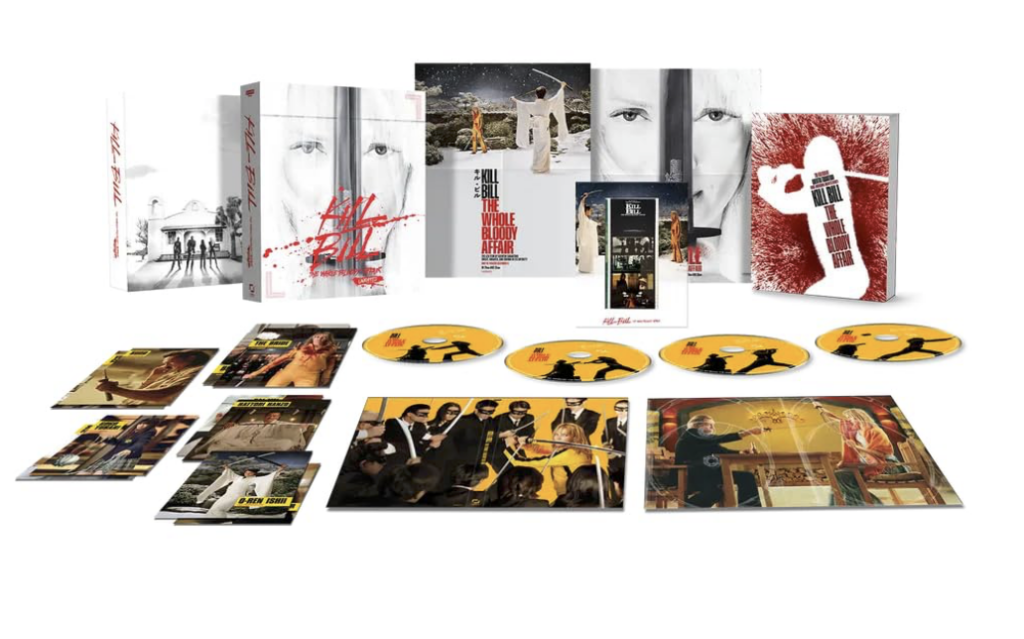
Now, at long last, we have Kill Bill: The Whole Bloody Affair, Tarantino’s original four-hour-plus conception, newly assembled and released by Lionsgate in 4K. For those of us who have spent two decades wondering what the complete beast might actually feel like, this should be a moment of pure cinematic ecstasy. And it is, until you discover that the four-and-a-half-hour movie is on two discs. I cannot emphasize this enough. You have to get up in 2026 during the intermission to change a disc.
We have put men on the moon. We have artificial intelligence writing emails we didn’t ask it to write. My refrigerator knows when I am running low on oat milk. And yet, if I want to watch Uma Thurman decapitate an entire Japanese nightclub, I must physically leave my chair and interact with my 4K player like I’m operating a LaserDisc machine in 1997. What is the point of progress?
The changes to The Whole Bloody Affair are, thankfully, far more exciting. The film opens with a dedication to Kinji Fukasaku rather than the Klingon proverb. The animated O-Ren Ishii sequence is longer and nastier. The Crazy 88 battle is presented entirely in color, with the sound of all that slicing, stabbing, and general occupational violence turned up considerably. The Bride’s interrogation of Sofie Fatale is extended, giving the dialogue more room to breathe and the menace more room to fester. The revelation that Bill knows The Bride is alive has been removed, and the recap that originally opened Volume 2 is gone as well.
There is also an intermission, which is sensible. After four-plus hours of Tarantino dialogue, blood, feet, swords, cigarettes, revenge, and men explaining things they absolutely do not need to explain, an intermission is not a luxury. It is a public service.
Revisiting Kill Bill: Volume 1 in 2026, what strikes me most is how audaciously Tarantino constructed the thing. He wasn’t merely making a martial-arts movie. He was rummaging through the history of cinema like a delighted maniac in a video store after closing time. Bruce Lee, samurai films, kung-fu pictures, spaghetti Westerns, anime, and exploitation cinema are all on display, and he grabs everything he loves and throws it into the same blender. And somehow, it works.
The House of Blue Leaves sequence remains one of the great action set pieces of the twenty-first century. The Bride walks into a room containing an army and walks out having apparently negotiated with gravity, anatomy, and several hundred gallons of stage blood. In the newly restored color presentation, the Crazy 88 sequence feels even more gloriously unhinged. Tarantino doesn’t simply choreograph violence here. He turns it into musical theater for people who have never been invited to the Tony Awards. And then there is Uma Thurman.
It is easy to become distracted by the swords and blood fountains and the director’s encyclopedic knowledge of obscure cinema, but Thurman is the movie’s beating heart. Beatrix Kiddo isn’t simply an efficient killing machine. She is wounded, furious, funny, terrified, determined, and, beneath all that yellow tracksuit and righteous vengeance, profoundly human. Thurman gives her an emotional gravity that keeps the movie from becoming merely a four-hour exercise in cinematic showboating.
Then comes Volume 2, which is where Tarantino does something rather remarkable. He slows it all down. After spending Volume 1 treating violence like a fireworks display, he suddenly becomes interested in what violence actually costs. The second film is quieter, stranger, and more melancholy. Beatrix is no longer simply hunting people. She is trying to understand the person she was, the person she became, and the family she lost. This is where the movie reveals itself to be, at heart, a love story.
Not a particularly healthy one, certainly. Bill is not exactly the sort of man you would recommend on a dating app. But the relationship between Bill and Beatrix gives the revenge story its emotional architecture. The anger isn’t merely about betrayal. It is about love, motherhood, identity, and the almost impossible desire to reclaim a life that has already been destroyed. That is why the final confrontation with Bill works as well as it does. After all the swords, bullets, blood, buried-alive sequences, and various assaults upon the human body, the climax is remarkably quiet. Tarantino understands that sometimes the most devastating thing a character can do is sit still and talk. It is a strange trick for a filmmaker who has spent hours making people lose limbs.
PURCHASE THE WHOLE BLOODY AFFAIR
The 4K presentation is excellent. The authentic 35mm photography looks terrific, even if this is an upscale from a 2K master rather than the sort of native-resolution restoration that makes collectors start breathing heavily. The DTS-HD 5.1 soundtrack, meanwhile, absolutely kicks the door down. Every sword slash, footstep, scream, and burst of mayhem has the kind of physical presence that makes you glance nervously at the neighbors.
There is also a new ten-minute animated short directed by Tarantino, centered on Gogo Yubari’s sister Yuki, who is understandably unhappy about what happened to Gogo. Zoe Bell contributes motion-capture work, and Uma Thurman makes a brief appearance. It is a fun little addition, although after waiting twenty years for The Whole Bloody Affair, I admit I was hoping for enough bonus material to fill a small wing of the Tarantino Museum.
Still, is it worth buying? Absolutely. For years, The Whole Bloody Affair was something American fans mostly encountered through rumors, bootlegs, whispered stories, and the cinematic equivalent of, “My cousin’s roommate has a copy.” Now it is real, official, and sitting beautifully in 4K. And then there is the disc. Two discs, well, four discs, two in Blu-ray and two in 4K. I keep coming back to this because it is so wonderfully, almost poetically stupid. Kill Bill is a movie about a woman overcoming seemingly impossible obstacles to get what she wants. In 2026, the obstacle standing between me and the second half of the movie is a piece of plastic.
Perhaps this is Tarantino’s final joke. After twenty years of waiting, the ultimate test of whether you truly love Kill Bill is not whether you can handle four and a half hours of revenge cinema. It is whether you are willing to get off the couch. And, apparently, I am.