LOST: Season 3 – Episode 23 “Through the Looking Glass”
There was a period in American life when Wednesday nights belonged not to God, family, or even football, but to a smoke monster, a polar bear, and a downed plane. The early two-thousands gave us many things we now regard with mild embarrassment, Bluetooth earpieces, low-rise jeans, the phrase “Fo’ Shizzle”, but perhaps nothing more emotionally destabilizing than the television phenomenon of Lost. The show arrived like a plane crash in our own living rooms. It was loud, disorienting, and weirdly human. And somehow, more than sixteen years after its finale, people still speak about it the way war veterans speak about seeing action in the jungle. “You watched it live?” they ask one another, with the solemnity of survivors comparing trenches.
Time, of course, was never especially stable on Lost. Characters skipped through decades, consciousnesses floated through timelines, and dead people wandered around in tennis shoes offering cryptic advice, and a polar bear materialized on a tropical island with the casual energy of a man entering the wrong conference room. Every week felt less like watching television and more like attending group therapy led by a philosophy major who had recently discovered hallucinogens. We asked impossible questions with complete sincerity, like “Are they on the island?” “Are they off the island?” “What exactly is the Dharma Initiative?” “Why does this hatch require so much typing?” and, most importantly, “How in God’s name did they train that polar bear?”
Yet beneath all the metaphysical smoke and quantum confusion, the series possessed something increasingly rare in modern television. It had genuine sentimentality. Not the manipulative sort with the swelling-violin, Emmy-reel sentimentality, but something bruised and human. These people were damaged long before Oceanic Flight 815 fell from the sky. The island merely stripped away their distractions. Beneath every mystery was another, quieter revelation. Everyone was lonely. Everyone wanted absolution, and everyone desperately hoped another person might tell them they were worthy of being loved.
Which brings us, inevitably, to Charlie Pace, the former rock star, recovering heroin addict, the front man for Drive Shaft, and patron saint of lovable disaster men everywhere. Played by Dominic Monaghan with the soulful panic of someone perpetually five minutes away from either redemption or catastrophe, Charlie began the series as comic relief with a drug problem and somehow evolved into the emotional heartbeat of the show. He was, in many ways, the most human character on the island. He was not a surgeon, fugitive, torturer, or millionaire, but simply a screw-up trying very hard not to screw up again.
Charlie’s backstory now feels almost painfully quaint in the age of algorithmic celebrity. He was a washed-up bassist from the fictional band Drive Shaft, best known for the immortal anthem “You All Everybody,” a song that sounded as though Oasis had been trapped inside a microwave. His fame had evaporated, his addiction had consumed him, and by the time the plane crashed, Charlie carried himself with the jittery sadness of a man who no longer believed he deserved a future.
But Lost loved redemption stories almost as much as it loved unexplained electromagnetic anomalies. Over the course of the series, Charlie became sober, fell deeply in love with Claire and her baby, Aaron, and slowly transformed into someone dependable. It is difficult to explain now, in an era where every television character must be either a genius sociopath or secretly evil, how moving it was simply to watch a man try to become better. Charlie did not want power or destiny. He wanted family. He wanted purpose, and he wanted, quite modestly, to matter.
And then came “Through the Looking Glass,” which is still one of television’s most devastating season finales. It’s a title borrowed from Through the Looking-Glass because Lost never met a literary reference it didn’t immediately throw into the ocean.
By then, Charlie had become the audience’s sacrificial lamb, though we did not yet realize it. Desmond, cursed with flashes of the future, kept seeing Charlie die over and over again in increasingly ridiculous ways, like the universe itself had taken out a restraining order against him. Lightning strikes. Arrows. Drowning. The island seemed determined to collect his soul like overdue rent. And Charlie, remarkably, kept accepting this fate with a kind of exhausted grace.
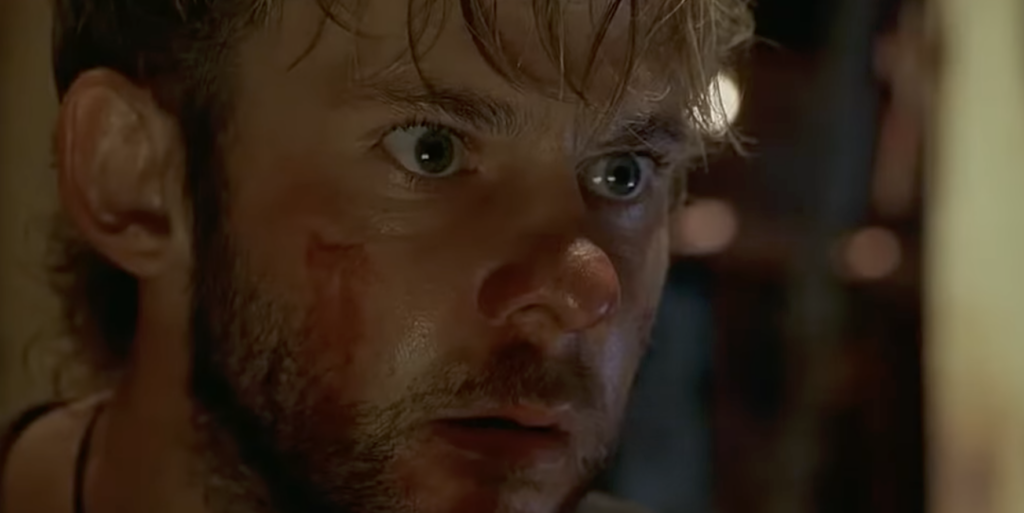
His final mission took him into the underwater Looking Glass station, where he successfully disabled the signal jammer, preventing communication with the outside world. Then came the explosion. Water rushed in. Panic bloomed. Desmond tried to save him. But Charlie, in one of the rare moments television truly earns the word “heroic,” shut the door and sacrificed himself so his friend could live.
And then, through the glass, he pressed his palm against the window and revealed those three words that instantly entered the pop-culture obituary column.
“Not Penny’s Boat.”
Few moments in television history have achieved such perfect emotional geometry. The message itself was horrifying, but it was Charlie’s expression with the acceptance, the sadness, and the strange peace that shattered people. Men who hadn’t cried since childhood suddenly found themselves staring silently at television screens while credits rolled. Entire dorm rooms reportedly went quiet. Somewhere, surely, a Blockbuster employee paused mid-shelving operation to gather himself emotionally.
The brilliance of Charlie’s death lies in its moral symmetry. Here was a man who began the series consumed entirely by his own pain and ended it by giving away his life for others. Lost often buried its emotional truths beneath layers of mythology and pseudo-scientific jargon, but Charlie’s story remained beautifully simple. It was that redemption is not a destination. It is a decision made repeatedly, often at terrible cost.
And perhaps that is why his death still lingers all these years later, long after audiences stopped arguing about the finale, the island, the smoke monster, or whether the writers were improvising the mythology with the confidence of jazz musicians. Charlie’s ending transcended the puzzle-box mechanics of the show. It reminded us that beneath every cosmic mystery is the smaller mystery of whether people can change.
Television rarely lets characters earn grace anymore. Modern prestige dramas prefer nihilism dressed in expensive sweaters. But Charlie Pace got something gentler. He got to become the person he always hoped he might be.