Futurama: Season 4 – Episode 7 “Jurassic Bark”
There are certain episodes of television that become cultural landmarks. People speak of them the way older generations talk about moon landings or where they were when Elvis died. Mention The Sopranos finale, and someone will have an opinion. Mention the “Red Wedding” in Game of Thrones, and someone will smirk with delight. But mention “Jurassic Bark” from Futurama, however, and watch a grown adult suddenly stare into the middle distance as if remembering a fallen comrade in war.
For anyone unfamiliar with Futurama, this reaction can seem absurd. How could a cartoon about a delivery boy frozen for a thousand years, a hard-drinking robot, and an elderly mad scientist possibly produce the most emotionally devastating half-hours ever aired on television? It sounds ridiculous on paper. It sounds even more ridiculous when you consider that the show routinely featured alien invasions, robot uprisings, drinking 100 cups of coffee in one day, and jokes about tax law in the twenty-ninth century.
And yet I would wager an embarrassing amount of money that almost anyone who watches “Jurassic Bark”, whether they have seen every episode a hundred times or have never watched a single second of Futurama, will end the experience searching for tissues as they ugly cry for the rest of the week.
When Futurama first appeared, it occupied a curious place in television. Created by the minds behind The Simpsons, it was the nerdier sibling. It was the one who spent weekends reading science-fiction novels and somehow made jokes about quantum mechanics seem effortless. The show was astonishingly smart without ever becoming smug or deeply silly without becoming disposable. It could deliver a joke about time travel and becoming your own grandfather, or a satire of consumer culture, and a heartfelt character moment, all within the same scene. Over the years, it accumulated awards, survived multiple cancellations, and returned from the dead more times than some of its characters, and quietly became one of the most beloved animated series ever made.
But none of that prepared viewers for “Jurassic Bark.”
The episode begins innocently enough. Fry and Bender visit a museum showcasing artifacts from the twentieth century. Among the exhibits is an ancient pizzeria remarkably similar to the one where Fry worked before he was accidentally frozen on New Year’s Eve in 1999. There, behind glass, Fry discovers the fossilized remains of his former pet dog, Seymour.
Already, the premise sounds like the setup to a joke. In lesser hands, it probably would have been. Instead, it becomes a meditation on love, memory, and loss.
Fry steals Seymour’s remains, which is an act that, somehow, feels entirely reasonable under the circumstances, and brings them to Professor Farnsworth, who believes he can clone the dog from preserved DNA. Suddenly, Fry has a chance to reunite with his oldest best friend.
The middle of the episode unfolds with characteristic Futurama charm. Fry excitedly prepares for Seymour’s return. Bender grows increasingly jealous, behaving like a robot-shaped toddler denied attention. Interspersed throughout are flashbacks of Fry and Seymour together in old New York. They are seen playing, wandering, singing songs, swimming in Italian sauce, and generally existing in the uncomplicated paradise that exists between a man and his dog.
These scenes are warm and funny. They lull the audience into a false sense of security, even to the song “Walking on Sunshine.”
Then comes the revelation.
Just before the cloning process begins, Farnsworth discovers that Seymour lived to be fifteen years old. Since Fry disappeared when Seymour was three, that means the dog survived another twelve years after Fry vanished.
Fry pauses for a minute.
The realization lands on him, and on us, in a way that initially seems comforting. If Seymour lived that long, Fry reasons, he must have found another family. Another owner. Another life. Surely he eventually forgot about the delivery boy who never came home.
So Fry makes the decision to let him rest and not bring him back.
“I’ll never forget him,” Fry says quietly, “but he forgot me a long time ago.”
It is one of the saddest lines in television history, largely because it is so profoundly wrong. What follows is less a scene than an emotional attack.
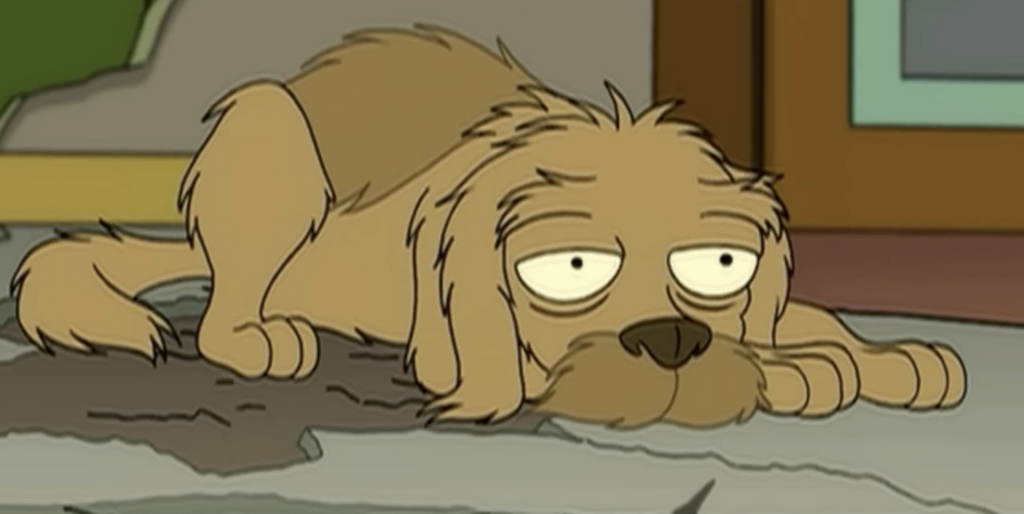
As Fry walks away, the episode cuts back to the past. Seymour returns to the spot where he last saw his owner. He waits outside the pizzeria. Days pass. Then months. Then years. People come and go. Businesses change. The city evolves around him. The seasons rotate endlessly as summer becomes winter and winter becomes spring. Seymour grows older. His muzzle turns gray. And his body slows.
But still, he waits for Fry.
The montage unfolds beneath Connie Francis’s aching rendition of “I Will Wait for You,” a song whose title alone feels almost cruel in retrospect. Every artistic choice in these final moments appears designed by people who woke up one morning and collectively decided to ruin an entire generation’s emotional stability.
The genius of the sequence is its simplicity. There are no villains. There are no misunderstandings and no dramatic speeches. Life simply happens, time moves forward, the world continues, and one small dog remains faithful to a promise that was never meant to last twelve years.
Eventually Seymour, now old and tired, lies down in the spot where Fry left him. He closes his eyes and passes.
And that is the end.
The first time I watched it, I sat frozen through the credits. The second time, I cried because I knew what was coming. Every viewing since has somehow made it worse. The episode bypasses whatever defenses adulthood teaches us to construct. It ignores irony. It ignores cynicism. And it ignores the comforting distance we usually maintain from fictional characters. It goes directly for the most vulnerable part of the human heart and stays there.
Perhaps that is because nearly everyone has known a Seymour.
Not necessarily a dog, although dogs seem particularly gifted at inspiring this kind of devotion. Maybe it was a pet that greeted you every day after school. Maybe it was the cat who slept at the foot of your bed for fifteen years. Maybe it was simply the realization that there are creatures in this world capable of loving us with a purity that often feels beyond our own abilities.
Whenever I think about “Jurassic Bark,” I immediately want to find my late Bug Dog and give her a hug and a kiss. Pets occupy a strange place in our lives. They are family members who never speak our language, yet somehow communicate things more honestly than most people ever do.
The final cruelty of “Jurassic Bark” is not Seymour’s death. It is that Fry never learns the truth. He never discovers that his dog waited for him. He never knows the depth of Seymour’s loyalty. The audience becomes the sole keeper of that knowledge. Perhaps that is why the episode lingers long after the credits roll. We know something the character never will. We all carry the weight of it for him.
And somewhere in the space between a science-fiction comedy and a Greek tragedy disguised as a cartoon, Futurama accomplished something extraordinary. It told a story about a boy and his dog that felt timeless. Not because it was sad, but because it was true. The world changes. Cities rise and fall. Entire centuries pass. And sometimes love is simply waiting for someone who never comes home.