There are Christmas movies, and then there are real Christmas movies. There are the respectable ones, where families rediscover one another over hot cocoa, Bing Crosby, or an improbably decorated tree. There are the loud ones, where Bruce Willis crawls through air ducts while Alan Rickman steals every scene. And then there is Eyes Wide Shut, Stanley Kubrick’s final film, which is a movie in which the ornaments glimmer like tiny surveillance cameras, the Christmas lights look less festive than nightmarish, and a married couple nearly detonates their entire relationship because one spouse dares to utter a single, catastrophically honest sentence. It is, without exaggeration, the greatest Christmas movie ever made. No, really, it is.
Most Christmas films are about gifts. Eyes Wide Shut is about temptation. Most are about forgiveness. Kubrick’s is about the impossibility of forgetting. The Nativity itself is built on faith, mystery, vulnerability, and a leap into the unknown. So is Eyes Wide Shut. Strip away the masks, Venetian capes, and enough candles to alarm every fire marshal in Manhattan, and what remains is a story about a man wandering through the night in search of something that will restore his faith in his marriage, in himself, and in the strange institution of love. It’s essentially A Christmas Carol if Ebenezer Scrooge had access to much better tailoring and infinitely worse decision-making.
People have spent more than a quarter-century trying to decode Kubrick’s swan song. Was it about secret societies or the elite 1%? Or was it about married dreams or the Illuminati? Maybe it was a commentary on the Freemasons or sexual repression? The answer to all of that is probably “yes,” but only because Kubrick delighted in asking questions far more than answering them. The movie’s greatest trick is convincing audiences that they’re watching a mystery when they’re actually watching a marriage. And what a marriage it is. Tom Cruise has never been better.
That sentence tends to provoke debate until people revisit the film and remember just how astonishingly vulnerable he is here. Cruise built an empire playing men who sprint toward danger with impossible confidence. Ethan Hunt hangs from airplanes. Maverick defies gravity. Jerry Maguire wins everyone over with a smile. Dr. Bill Harford, meanwhile, spends two-and-a-half hours wandering New York looking increasingly confused, emasculated, and spiritually jet-lagged. Every room he enters seems designed to remind him that he isn’t nearly as special as he imagined.
It’s one of the bravest performances of his career precisely because it weaponizes his movie-star charisma against him. Cruise doesn’t play Bill as a fool. He plays him as someone discovering that confidence is an outfit you can accidentally leave at home. Across from him, Nicole Kidman delivers one of cinema’s all-time great acts of emotional sabotage. Nothing explodes during Alice Harford’s famous confession. No one storms out, and nobody throws a wine glass. She simply admits that, once upon a vacation, she briefly fantasized about another man so intensely that she would’ve abandoned her husband and child for one impossible night. That’s it. It was one fantastical idea.
Christopher Nolan built Inception around the notion that an idea, once planted, becomes almost impossible to remove. Kubrick understood that years earlier. Alice doesn’t cheat. She doesn’t even come close. She merely implants a thought into Bill’s head, and from that moment forward, the entire architecture of his marriage collapses under the weight of imagination. Every encounter Bill has afterward becomes infected by jealousy, insecurity, projection, and paranoia. Kubrick knew that marriages rarely implode because of singular catastrophic events. More often, they erode because two people can never fully know what the other is thinking. The scariest thing in Eyes Wide Shut isn’t the masked orgy. It’s honesty. And like Love Actually told us consistently, you tell the truth at Christmas.
Kubrick, who was in his seventies when he completed the film, somehow managed to make one of the youngest movies of his career. Not young in age, but in curiosity. Directors often mellow with time. Kubrick became even more fascinated by uncertainty. Rather than providing neat conclusions, he left audiences with a cinematic Rorschach test wrapped in Christmas lights. It’s also one of his most visually intoxicating achievements. Every frame glows like it has been dipped in expensive perfume.
The white lights hanging across New York and inside the wealthy homes don’t merely illuminate their rooms, but rather, they bleach reality itself. Christmas decorations become halos one moment and interrogation lamps the next. Every storefront seems to shimmer with impossible brightness, making the city feel both inviting and artificial, like a dream that’s trying a little too hard to convince you it’s real. Then there’s the blue. Kubrick uses blue the way composers use minor chords. Bedrooms dissolve into icy melancholy. Hallways become emotional refrigerators. Shadows feel less black than cobalt. The white lights promise warmth, however, the blue quietly reminds you that loneliness has entered the room before anyone else has.
Then the camera, naturally, behaves like an omniscient ghost. Kubrick’s famously deliberate tracking shots don’t simply follow characters. Rather, they stalk them. The camera glides with an unsettling patience, as though it already knows everyone’s fate and is politely waiting for them to catch up. Watching Eyes Wide Shut sometimes feels like floating through someone else’s subconscious. The movement is hypnotic enough that you don’t notice how carefully every hallway, doorway, and mirror has been positioned until long after the credits roll.
Then comes Jocelyn Pook’s unforgettable score, which deserves to be mentioned alongside Bernard Herrmann’s work for Hitchcock whenever discussions turn to music that permanently alters a film’s DNA. That solitary piano motif might be one of the most unnerving pieces of music ever written. Three notes shouldn’t be capable of inducing existential dread, yet somehow they do. Pook mixes sacred choral voices with sounds that seem to emerge from forgotten cathedrals, making every scene feel suspended somewhere between confession and nightmare. It’s less a soundtrack than an incantation.
Which brings us to the sex. Poor Eyes Wide Shut. For years, it was marketed as the movie where Tom Cruise and Nicole Kidman, the biggest celebrity couple on Earth, would finally let audiences peek behind the curtain. What they delivered instead was something infinitely stranger. Kubrick wasn’t particularly interested in eroticism. He was fascinated by desire itself. He was captivated by that maddening space between fantasy and reality where human beings become their least rational selves.
Even the infamous masked orgy is remarkably unerotic. Everything is choreographed with ceremonial precision. Bodies become architecture. Faces disappear beneath masks. And sex is transformed into ritual, commerce, theater, and ultimately intimidation. Rather than celebrating intimacy, Kubrick depicts the terrifying absence of it. It’s difficult to think of another film where nudity feels so emotionally cold. Maybe Schindler’s List. And yet, somehow, the movie remains deeply romantic. Not because Bill and Alice possess a perfect marriage. They absolutely do not. But because Kubrick suggests that surviving another person’s imagination might actually be love’s highest achievement.
The final scene lands like a quiet Christmas miracle. After hours spent chasing fantasies, conspiracies, and projections, similar to the three Christmas ghosts, Bill and Alice arrive at the only place that matters. It’s each other. The film’s legendary final line has become one of cinema’s great punchlines, but beneath its mischievous grin lies something profoundly moving. Christmas, after all, isn’t about perfection. It’s about grace, and it’s about returning home after wandering through the darkness.
Few filmmakers could have ended a career with something this mysterious, this funny, this erotic, this terrifying, and this heartbreakingly human. That Kubrick did so at the very end of his life only deepens the achievement. Eyes Wide Shut doesn’t feel like the work of an aging master taking a victory lap. It feels like someone is still asking impossible questions with the curiosity of a film student.
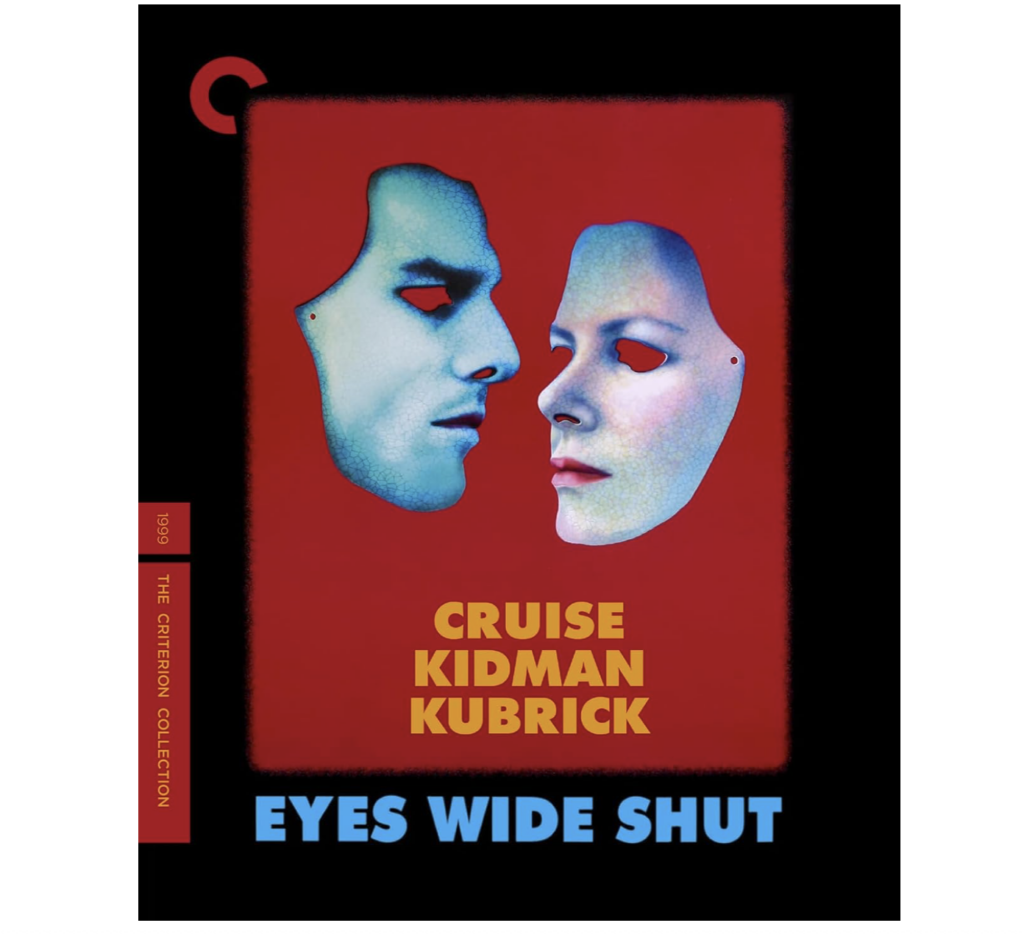
PURCHASE EYES WIDE SHUT CRITERION
Criterion’s 4K Blu-ray release reminds you just how miraculous the movie really is. The restoration is nothing short of revelatory. Kubrick’s intricate lighting finally receives the treatment it deserves. The dazzling whites possess a luminous softness rather than harsh digital glare, while the blues sink into astonishing depths without swallowing detail. Every Christmas bulb seems individually alive, every velvet curtain impossibly tactile, every candle flame capable of warming the room. Grain remains gloriously intact, preserving the rich texture of late ’90s celluloid instead of sanding it into sterile perfection. The audio is equally transporting. Pook’s haunting score envelops the room with remarkable clarity, allowing every whispered conversation, distant footstep, and unnerving piano note to linger just a little longer than your comfort level would prefer. Kubrick always understood silence as well as sound, and the mix honors both with extraordinary care.
Criterion also fills the package with thoughtful supplements that explore the film’s production, Kubrick’s meticulous working methods, its adaptation from Arthur Schnitzler’s Dream Story, and the decades of criticism and reinterpretation that have transformed Eyes Wide Shut from a misunderstood curiosity into a modern masterpiece. Like the best Criterion editions, the bonus features don’t explain away the mystery. They simply give you more fascinating ways to get lost inside it.
Rewatching Eyes Wide Shut every December has quietly become one of my favorite holiday traditions. While everyone else is revisiting snowmen, reindeer, and miracle workers, I prefer watching Tom Cruise wander through a city glittering with Christmas lights while his entire worldview slowly disintegrates. It somehow leaves me feeling oddly hopeful. Maybe that’s Kubrick’s final joke. His last film isn’t really about sex. Or conspiracy. Or masks. It’s about the terrifying privilege of loving another person enough to let them remain unknowable. Now that’s a fantastic Christmas story.