Korean cinema, as far as the average American pop-culture consumer is concerned, arrived like a thunderclap sometime between the first global “Oppa Gangnam Style” outbreak and the hypnotic rise of K-Pop Demon Hunters, which is a film that convinced countless children worldwide that the best way to cope with reality was to sing in unison while hunting supernatural creatures. But like most pop-cultural revelations, this one suffers from a chronic case of selective memory. Korean cinema didn’t materialize overnight in a glittery burst of neon choreography. It has, in fact, been here the whole time, quietly refining itself, and politely waiting, like an impeccably dressed guest ringing the doorbell while we pretend we’re still showering.
Truthfully, this belated discovery says more about us than it does about Korea. We Americans do love to believe we’ve “found” something as soon as it becomes convenient. But Bong Joon Ho was already making masterpieces before Parasite arrived in 2019 and obliterated the Oscars with the precision of a well-timed meteor. The man gave us The Host, a monster movie with genuine heart; Snowpiercer, a train ride so stressful it required emotional seatbelts; and Okja, a film that made millions contemplate adopting a giant super-pig. Meanwhile, Train to Busan reinvented the zombie genre with more emotional heft than three seasons of prestige American television. And then came Squid Game, which turned the world into a mass of armchair contestants convinced they could survive Red Light, Green Light despite struggling to merge onto the highway during rush hour.
But if you were alive in the early 2000s and spent your weekends renting DVDs from a video store run by a disinterested philosophy major, then Korean cinema’s real thunderbolt arrived in 2003. That was the year Park Chan-wook dropped Oldboy into the global consciousness. This was a film that felt like being lovingly slapped awake. It had everything. It had hammers, ballets, hypnotic revenge, and a twist so psychologically devastating it forced even veteran directors to whisper, “Okay… maybe let’s pack it up.” Park became the type of name cinephiles casually dropped into conversation to signal taste, refinement, and a tolerance for emotional distress.
From there, Park built an oeuvre that ranged from operatic vengeance (Lady Vengeance) to an erotic historical fever dream (The Handmaiden) to a vampire love story so perversely tender (Thirst) it made Dracula look emotionally unavailable. His films radiate the kind of confidence that makes even ordinary scenes feel charged with electricity, as though every shot knows exactly where it wants to go and how many layers of meaning it intends to smuggle in under your skin.
Which brings us to No Other Choice, Park Chan-wook’s newest, slyest, and perhaps most strangely tender film. It’s an adaptation of Donald Westlake’s The Ax that feels all at once biting, poignant, hilariously bleak, and unexpectedly warm. If Oldboy was his thunderbolt, No Other Choice is his slow-burn ember, the kind of film that glows long after the credits roll, flickering in the corners of your mind like a memory you’re not sure you should be laughing at.
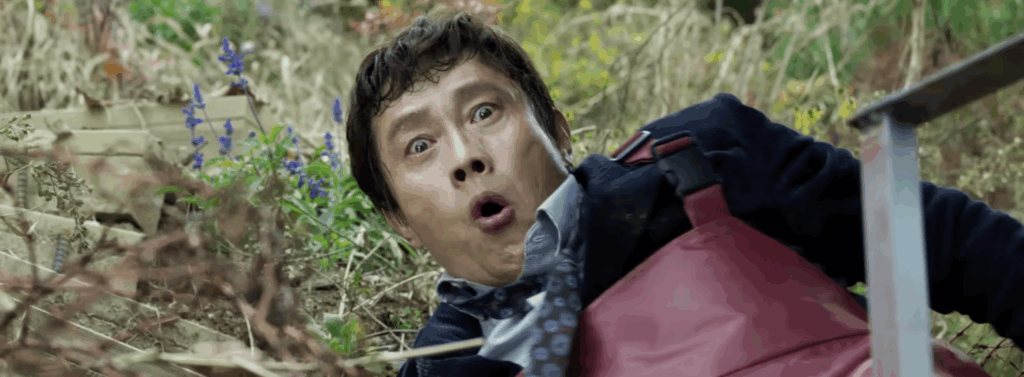
At the center is Yoo Man-su, played with sly brilliance by Lee Byung-hun (the villain in Squid Games), a man whose resting face alone could give you bad dreams. But here he plays against type, embodying an earnest, lovable paper-industry professional and devoted family man. Yoo is the kind of guy who packs lunches, remembers birthdays, and folds laundry with the attentive care of someone who knows his spouse is keeping score. So when his CEO announces mass layoffs under the banner of “cost-cutting,” Yoo becomes collateral damage in a corporate restructuring plan designed by people who probably use “synergy” unironically.
Once unemployed, Yoo and his family spiral into the familiar rituals of middle-class austerity. Streaming services get canceled. Brand names become generic. Takeout becomes a historical artifact. There’s even a pointedly hilarious moment where the family must part with Netflix, a wink so cheeky it could have sprained its own face, given Lee’s role in Squid Game. Park directs these quiet humiliations with wicked precision. He understands that sometimes losing your job feels less like a catastrophe and more like dying a slow death by a thousand budget cuts.
Then comes the job interview sequence, which is, without exaggeration, one of the most painfully accurate depictions of workplace absurdity in recent cinema. If you recall Spud’s meltdown in Trainspotting, you’ll recognize the spiritual lineage. Park shoots Yoo’s interview with the intensity of a psychological thriller. It’s oppressive lighting, inane questions, and too many interviewers staring at him like an underperforming lab mouse. In this scene alone, Park captures a universal truth, namely, that the modern job interview is a uniquely American torture ritual designed to determine whether you can answer “What’s your greatest weakness?” without bursting into tears.
Faced with rejection after rejection, Yoo arrives at a solution so startlingly simple it borders on inspired sociopathy. He will eliminate the competition. Literally. Why compete with other candidates when you can… remove them? What sounds like the premise of a grim slasher film instead becomes a darkly comic odyssey. The “kills” are bumbling, strangely sweet, and occasionally heartfelt, if such a word can be applied to workplace manslaughter. Yoo does not become a serial killer so much as a stressed father who has decided that murder, in this particular job market, is simply another form of professional networking.
Yet Park refuses to let this premise devolve into shock or cynicism. Instead, he crafts a deeply human portrait of a man whose desperation reveals not his monstrousness, but his steadfast love for his family. The violence becomes oddly tender, even funny, as Yoo stumbles through each attempt with the earnest clumsiness of someone assembling IKEA furniture without instructions. And the film’s bookending scenes are brilliantly ironic, highlighting the absurdity of corporate culture, where employees are both expendable and essential, invisible until they’re suddenly very, very missed.
Visually, Park remains an artisan of the highest order. His transitions flow like whispered secrets. His color palette toggles between sterile corporate greys and lush natural tones that seem to breathe on screen. Watching No Other Choice feels like watching a man made of paper reshape himself, folding, creasing, transforming, until he emerges the same but irrevocably changed.
The result is a darkly funny, unexpectedly moving meditation on work, identity, and the small violences of modern life. It’s one of those rare cinematic experiences that lingers, not because it traumatizes you (though Park has done that before), but because it makes you laugh at things you probably shouldn’t and feel for a man you’re not entirely sure you’d trust alone with a chainsaw.
No Other Choice is one of Park Chan-wook’s finest achievements. It’s a film both savage and sweet, brutal and tender, and as precise as a scalpel and as human as a family dinner with cute puppy dogs in rain coats. See it as soon as possible. Preferably before the job market gives you any ideas.