The Simpsons: Season 7 – Episode 8 “Mother Simpson”
Sadness is not generally what one expects from The Simpsons. You expect yellow people strangling one another affectionately, a donut budget larger than the GDP of several island nations, and the sort of jokes that permanently alter the way you say the word “excellent.” The show has been on the air so long that it has ceased being merely a television program and become something closer to life itself. It’s reliable, omnipresent, and occasionally catastrophically funny. And yet, every so often, amid the prank calls to Moe’s Tavern and the squirrelly saxophone solos of Lisa Simpson, the series sneaks up behind you with the emotional force of a monorail wrapped in irony.
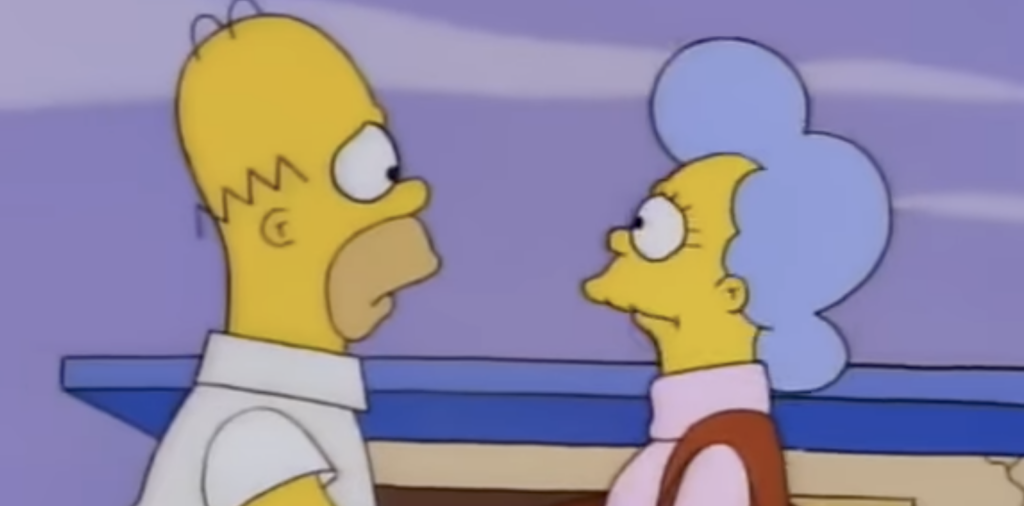
Most people point to the famous “Do It For Her” moment, which was the revelation that Homer continues to suffer through the fluorescent purgatory of the Springfield Nuclear Power Plant because Maggie, his silent pacifier-chewing daughter, gave his miserable life the most purpose, you know, besides a Duff beer. It is devastating in the way only a sitcom can devastate you. But for me, the emotional apex of the series arrives in “Mother Simpson,” the episode in which Homer meets his mother for the first time in twenty-seven years and suddenly becomes something television rarely allows him to be, a wounded little boy.
The episode begins, as all great tragedies should, with workplace fraud. Mr. Burns forces the plant employees to clean a highway, and Homer, who has committed a lifelong mission of avoiding labor, fakes his own death to get out of it. It’s genius, really. This feels spiritually correct for Homer Simpson, a man who would fake his own funeral if it meant skipping a parent-teacher conference. Soon, however, the bureaucratic mess of being legally deceased sends him to a government office, where he stumbles onto the impossible truth. That his mother, whom he believed died when he was an infant, is actually alive.
Only The Simpsons could pivot from a joke about administrative incompetence to existential heartbreak in under four minutes.
Homer, naturally, goes to the cemetery to investigate, only to discover that his mother’s grave belongs to Walt Whitman. The joke lands because Homer somehow recognizes Whitman, which is perhaps the least believable thing that has ever happened in Springfield. Moments later, Homer falls into an open grave intended for himself, which is a bit of slapstick so morbid it practically qualifies as Bergman, and an elderly woman helps pull him out. It is, in fact, his mother.
Their embrace is animated awkwardly by today’s standards, but emotionally it feels almost too raw for television. Homer doesn’t cry immediately. He does something sadder. He jokes. He babbles. He becomes sentimental in that uniquely Homer way, where every joke sounds like it is covering for panic. Anyone who has ever reunited with someone they loved after too much time has passed recognizes the feeling instantly. It’s the desperate urge to keep talking so the silence doesn’t reveal how damaged you actually are.
And then comes the line that quietly wrecks the episode.
“I guess I was just a horrible son, and no mother would want me.”
It’s a line delivered with the offhand simplicity of a child saying something embarrassing at dinner, which somehow makes it worse. Marge reassures him that he is sweet and loving, and Homer replies, “Then why did she leave me?” There it is. That’s the central terror of childhood condensed into seven words. Every abandoned kid, every divorced parent’s son, and every adult still carrying around invisible bruises from adolescence hears that line and immediately becomes twelve years old again.
What follows is surprisingly political for a prime-time cartoon about a baby who shoots people with a pacifier. Homer’s mother, voiced beautifully by Glenn Close, explains that she became involved with a hippie protest movement opposing Mr. Burns’s biological experiments. In classic Springfield fashion, the movement destroys the germ lab, the town tramples Burns nearly to death, and Mother Simpson becomes a fugitive after returning to make sure the old tyrant survived. It is absurd, sincere, and vaguely anti-establishment in the way only ’90s television dared to be.
But the genius of the episode is that it never lets the politics overshadow the intimacy. The revelation that she sent Homer care packages every week, which were little tokens of love floating forever in bureaucratic limbo, is almost unbearably sad. There is something especially cruel about undelivered affection. It suggests a universe where love existed the whole time but simply never arrived at the right address.
Eventually, of course, the police spot her, and she has to disappear again. Because this is The Simpsons, and happiness is always temporary, like a snow day or a non-ironic conversation with Bart. Before leaving, she tells Homer, “Remember, whatever happens, you have a mother, and she’s truly proud of you.”
For a show built on cynicism, this moment is almost alarmingly earnest.
And then comes the final scene, which may be the most haunting ending the series has ever produced. Homer sits alone on the hood of his car beneath a sky full of stars while Alf Clausen’s score drifts quietly in the background. There are no jokes, no cutaways, and no punchline arrives to rescue the audience from sincerity. The camera simply lingers as Homer looks upward, processing the impossible fact that somewhere out there is a mother who loves him.
The scene goes on longer than you expect. Long enough to make you uncomfortable. And long enough to feel real.
That is what makes it so devastating. Homer Simpson, the patron saint of incompetence, gluttony, and half-baked schemes, finally experiences, for one silent minute, a kind of emotional completeness. He is no longer merely the idiot father on the couch, strangling Bart between commercials. He is a son. And for perhaps the first time in his life, he knows he was wanted. Which is more than enough to make even the most cynical viewer reach for the tissues between laughs.
WRITTEN BY: BRYAN KLUGER
Bryan Kluger is an entertainment critic, writer, and podcast host with a deep love for film, horror, and pop culture. His work has appeared in outlets such as Arts+Culture Magazine, High-Def Digest, Screen Rant, The Huffington Post, The Drudge Report, Fark, and Boomstick Comics. He hosts My Bloody Podcast and Fear and Loathing in Cinema Podcast, along with a weekly radio show, where he brings sharp insight, humor, and an unabashed passion for movies to every conversation.