There is something almost spiritual about the way American men talk about ’80s action movies. If you mention Top Gun or Predator at a barbecue and suddenly every dad and manly man within a 30-foot radius starts speaking in movie quotes like they’re reciting scripture. Someone flexes unconsciously. Someone says the phrase “they don’t make movies like that anymore” with the same sadness usually reserved for discussing extinct species or affordable rent. Another man stares wistfully into the middle distance, remembering a time when heroes solved international crises with shoulder-mounted rocket launchers and teeth clenched so hard they could crack diamonds.
And perhaps they’re right. They really do not make movies like that anymore. Modern action heroes spend half their runtime discussing trauma or multiverse theory. The heroes of the ’80s barely discussed anything except revenge, muscles, and whether another man was flying too close to their tail. It was a better time.
But revisiting those movies as an adult is a startling experience, because what once felt like the apex of heterosexual masculinity now plays as a two-hour YMCA calendar shot through a Vaseline-coated lens. The explosions are still there. The car chases still rule. And the synth scores still make you want to sprint through a brick wall. Yet beneath all the bullets and patriotic chest-thumping lies something impossible to ignore. Nearly every great ’80s action movie is profoundly, deeply, and hilariously homoerotic.
Not accidentally homoerotic, either. Not “if you squint hard enough and took one semester of film theory” homoerotic. No. These movies are lit, framed, and edited like they were directed by people who sincerely believed men should spend 90% of their day sweating in locker rooms while maintaining intense eye contact with their best friend.
And the strangest part is that nobody noticed. Or maybe everybody noticed and collectively agreed not to bring it up because the Cold War was stressful enough already. Those damn Russians, am I right?
Take Commando, a movie in which Arnold Schwarzenegger carries tree trunks the way normal people carry groceries and hand-feeds a baby deer. The villain Bennett arrives dressed less like a mercenary and more like the world’s most dangerous leather-daddy bartender. Chain-mail vest. Tiny gloves. Leather pants so tight they appear vacuum-sealed onto his body. And a handle bar mustache twirled with enough precision to suggest he absolutely owns at least a dozen disco records. Bennett doesn’t merely menace Arnold. He practically purrs at him.
Every scene between them feels less like mortal enemies and more like a couple arguing outside a West Hollywood nightclub at two in the morning.
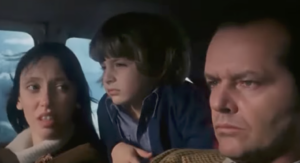
Then there’s A Nightmare on Elm Street 2: Freddy’s Revenge, which abandoned subtlety entirely and essentially said, “What if Freddy Krueger was also a metaphor for repressed sexuality?” A young man spends the film terrified of what’s inside him while wandering through gay bars and getting attacked in gym showers via towel slaps. At one point, a coach is stripped naked and killed with towels in a scene possessing the exact energy of a panic attack at Fire Island. It is less horror movie than an accidental thesis statement on the LGBTQ community.
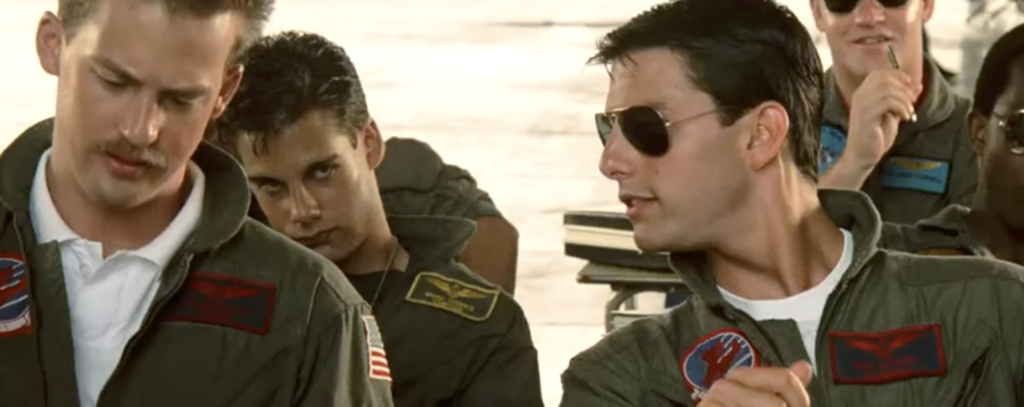
But all roads lead back to Top Gun, the Mount Rushmore of accidental gay iconography. Watching it now is like discovering your dad’s old football team photos and realizing everyone involved was one saxophone solo away from listening to Barbara Streisand on repeat and dancing on a float in that annual fabulous parade.
The film’s reputation has long been wrapped in American patriotism. People speak of it as if it single-handedly defeated communism through aviator sunglasses and beach sports. Recruiters famously parked Navy booths outside theaters because young men emerged from screenings desperate to pilot fighter jets or at a minimum purchase bomber jackets. There was a 10% increase in new Navy members in 1986. Yet the movie itself feels astonishingly unconcerned with combat. The actual enemy pilots barely register as characters. They’re masked and barely on screen. They’re not even called Russians, but then again, back then, Russians really weren’t considered people. The true emotional stakes revolve around whether Maverick can emotionally connect with the beautiful blond man glaring at him across the classroom.
Tom Cruise plays Maverick with the emotional volatility of a man one rejection away from writing poetry in a journal. Nearly every line out of his mouth sounds unintentionally flirtatious. He talks endlessly about flying with other men, showering with other men, competing with other men, and proving himself to other men. Kelly McGillis is technically present in the film, but she often feels like someone wandered in from an entirely different movie, perhaps a PBS drama about tenure disputes.
This is Charlie, the blonde bombshell sent into the film like a panic button pressed by studio executives who suddenly realized their Navy recruitment commercial had accidentally become an arthouse romance between mustachioed pilots. Her entire purpose seems to be convincing Maverick that he is, in fact, interested in women, despite all available evidence suggesting otherwise.
The problem is that Maverick reacts to Charlie the way a teenager reacts to a mandatory family dinner. He is polite. He is distracted. And he is emotionally elsewhere. This man has more chemistry with volleyballs and rival pilots than with the woman literally throwing herself at him in soft-focus lighting.
And then something fascinating happens. Charlie pulls her hair back, throws on the male-issued Navy uniform, lowers the glamour quotient, and suddenly Maverick perks up like a Labrador hearing the treat bag rustle. For the first time in the entire movie, he appears remotely interested in her. The romantic breakthrough only occurs once she starts looking less like a blonde bombshell and more like another guy hanging around the hangar.
The movie practically tells on itself.
Because the second Charlie returns to looking overtly feminine again with her hair flowing, vulnerability exposed, and all traces of “one of the boys” are gone, what does Maverick do? He emotionally ejects from the cockpit. The man practically flees into the night like he just remembered he left the stove on in another state. He doesn’t lean into romance so much as recoil from it. And honestly, the film is set in the Navy. At a certain point, the jokes simply begin writing themselves.
Even the dialogue in Top Gun sounds less like military jargon and more like rejected double entendres from late-night cable television. At one point, a pilot declares, “He’s on our tail, coming hard,” which may technically describe aerial combat but also sounds like something overheard outside a Farmer’s Market in San Francisco circa 1987.
The miracle of the movie is not that these moments exist. It’s that generations of straight men watched all of this. The shirtless, oiled up men, the volleyball, longing stares, emotionally codependent pilots, and lines about tails, and then walked away saying, “Hell yeah, brother. Jets.”
Meanwhile, Iceman, played by Val Kilmer with impossibly perfect blond hair and the confidence of a runway model at a military academy, spends the film radiating romantic frustration. He stares at Maverick with the expression of someone thinking, “I can fix him.” Their rivalry contains more chemistry than Maverick’s entire relationship with Charlie. Every confrontation feels one orchestral swell away from turning into a forbidden kiss near a locker.
And Goose. Dear God, Goose.
Goose is ostensibly Maverick’s co-pilot, but emotionally, he is the film’s exhausted spouse. He supports Maverick’s reckless behavior. He worries about him constantly. And he follows him around like a man who has spent years cleaning up after emotional disasters. When Goose dies, the movie transforms from an action film into pure melodrama. Maverick mourns with the intensity of a 19th-century widow staring out at sea, waiting for a sailor who will never return.
The scene where Maverick cradles Goose’s body has all the emotional restraint of an opera. It is devastating, earnest, and just intimate enough to make you wonder how nobody in 1986 paused and said, “Fellas… what exactly are we making here?”
And then comes the volleyball scene, perhaps the most unintentionally revealing sequence in blockbuster history. Calling it “a game” feels inaccurate. It is closer to an athletic mating ritual. Bodies glisten under the golden California sunlight. Sweat sparkles artistically off every ab. And all of the men collide in slow motion while Kenny Loggins sings “Playing with the Boys” with a level of sincerity bordering on camp masterpiece. Nobody appears remotely interested in volleyball itself. The ball is essentially decorative here. The real objective is touching another man’s torso and butt while pretending it’s competitive. “See ya in the showers”, was probably uttered.
If Michelangelo had directed a Gatorade commercial, it would look exactly like this.
The thing is, these movies genuinely believed they were celebrating ultimate masculinity. The ’80s worshipped the muscular male body with almost religious devotion. Reagan-era cinema turned action stars into mythological figures with towering physiques wrapped in denim and ammunition belts, solving problems through violence and jawlines alone. Yet in doing so, Hollywood became obsessed with photographing men beautifully. Tenderly, even. Cameras lingered lovingly on sweat, muscles, mustaches, and pouting stares.
The result is a genre constantly trying to prove heterosexual toughness while accidentally drifting into queer iconography so obvious it practically winks at the audience. And audiences adored it.
Top Gun became the highest-grossing film of 1986 because America was absolutely ready for it, even if America didn’t quite understand what “it” was. The country wanted patriotism, swagger, danger, and beautiful men photographed like Renaissance sculptures emerging from machine oil.
There is something weirdly wholesome about that contradiction now. Beneath the macho posturing and anti-Soviet bravado, these movies unintentionally revealed how performative masculinity can be. They were terrified of softness yet obsessed with male beauty. They insisted on toughness while constantly drifting into longing. They shouted about dominance while quietly creating some of the gayest imagery ever projected onto multiplex screens.
And honestly, maybe that is why they endure. Strip away the nostalgia and explosions, and what remains is pure cinematic license, which is that men are desperate to impress one another while pretending they are not staring too long. The jets were fast. The explosions were loud. But the real fuel powering ’80s action movies was unresolved tension between sweaty men wearing aviators.
The Village People knew it. Hollywood knew it. Somewhere deep down, America probably knew it too. And that’s why we celebrate Top Gun.