There are comedians who tell jokes, and then there are comedians who seem to have accidentally wandered into the human condition, looked around for a while, and returned with a grocery bag full of punchlines. Louis C.K. has occupied that peculiar corner of comedy since the Clinton years, making ordinary embarrassment feel like great literature with worse language. The red hair, the freckles, the permanent expression of a man who has just discovered his car has been towed have all become part of the act. He makes self-loathing look less like therapy than a spectator sport.
His best material has always lived in the tiny places most comics ignore. A throwaway observation about the lone little girl in Schindler’s List whose only line is “Goodbye, Jews,” somehow becomes a masterclass in comic escalation. On Louie, he once spent several glorious minutes trying to convince his financial manager that he could absolutely afford a $14 million apartment despite possessing something closer to pocket lint than a down payment. He has long possessed that increasingly rare ability to make the absurd feel inevitable.
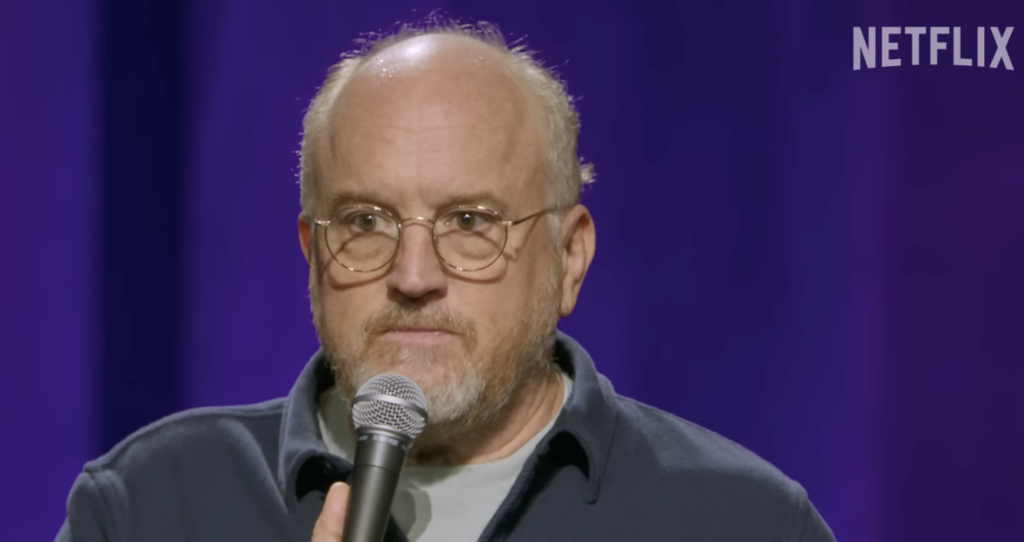
Now comes Ridiculous, his first Netflix special since 2017, after several years of releasing his work directly through his own website, which is a stubbornly independent move that also spared fans the annual ritual of sacrificing both dignity and bank accounts to Ticketmaster’s convenience fees. By now, this is also his fifth special since his very public fall from grace, which is perhaps why he addresses it with the confidence of someone who knows everyone in the room already knows the story.
The first joke lands before the audience has fully settled. “I took an AIDS test today. I haven’t had sex in six years. I just wanted some good news.”
It is classic Louis C.K. It’s self-inflicted, economically written, and somehow topical without ever sounding like it is chasing headlines. Then, because restraint has never been his preferred mode, he follows it with the sort of Looney Tunes absurdity only he could deliver with a straight face, “Well, I fucked a gay rat and got AIDS.”
Read on paper, it sounds deranged. Spoken by C.K., it becomes something stranger. It’s childish, grotesque, and weirdly innocent. It’s like hearing an eight-year-old invent profanity for the first time. His gift has always been making the audience laugh before they’ve had time to consult their own moral compass.
The subjects remain familiar throughout Ridiculous. Death, bodily functions, aging, sex, and the Holocaust are the kinds of conversational landmines most people spend their lives avoiding. But familiarity has never been the point. C.K. doesn’t simply revisit taboo subjects. He rearranges them until they resemble something unexpectedly human. A joke about his late mother begins with the reassuringly mundane, “Of course I don’t breastfeed from my mother anymore.” He waits just long enough for the audience to become uncomfortable before adding, “Because we had her cremated.” It’s juvenile, affectionate, morbid, and oddly sweet all at once, which is to say, is unmistakably Louis C.K.
Like contemporaries such as Shane Gillis, Tony Hinchcliffe, and Ari Shaffir, he understands that taboo isn’t inherently funny. The laugh comes from balancing on the narrow rail between cruelty and absurdity without tumbling into either. Few comics still walk that line with this much confidence.
The special is at its strongest, however, when C.K. stops trying to shock and starts simply paying attention. He complains about living in New York. He studies his increasingly unreliable body with the detached disappointment of a mechanic inspecting a rusted transmission. And he jokes about death not as a philosophical abstraction but as an appointment creeping closer on the calendar.
The longest and richest section follows him and his sisters as they move their aging father into a nursing home. Here, Ridiculous briefly becomes something almost tender. C.K. notices the pink plastic water pitchers, the antiseptic sameness of every hallway, and the quiet tragedy of a father now too old to meaningfully resist where life has decided to place him. Anyone who has helped an aging parent through those final logistical humiliations will recognize the ache beneath the laughter.
That has always been Louis C.K.’s real subject. It’s not controversy or vulgarity, but it’s the humiliating business of being a person. His comedy is built from the moments we’d rather not admit we’ve experienced, but he’s polished them until they become impossible not to laugh at.
Whether you admire him, dislike him, or have long since made up your mind about the man himself, Ridiculous offers one conclusion that feels difficult to dispute. Louis C.K. remains one of the sharpest joke writers working today. For all the noise that has surrounded him over the past decade, the essential fact hasn’t changed. When he steps onstage with a microphone, he’s still devastatingly funny.