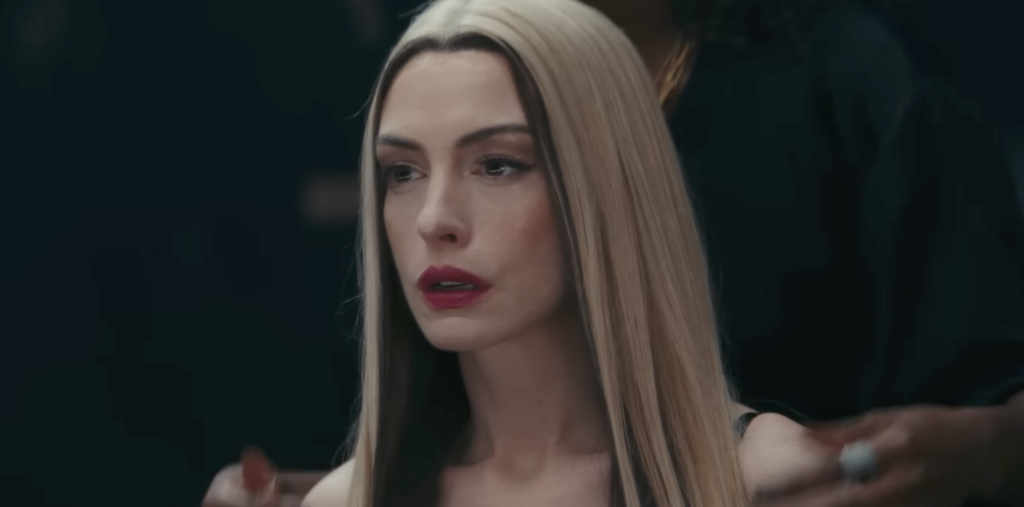
With a title like Mother Mary, you might reasonably brace yourself for incense, suffering, and at least one solemnly lit crucifix. You know, the sort of film that arrives draped in velvet and leaves you emotionally flagellated. Instead, David Lowery, a Texas native with a gift for turning stillness into something like revelation, offers something stranger, slipperier, and, in its own way, quietly ecstatic.
Lowery, whose previous works (A Ghost Story, The Green Knight, Ain’t Them Bodies Saints, and yes, the improbably tender live-action Pete’s Dragon) tend to unfold like half-remembered dreams. Now, he has made a film that feels less like a departure than a sideways evolution. If anything, Mother Mary is his most mischievous sleight of hand yet. It advertises itself, politely and almost coyly, as neither horror nor romance, which is rather like saying a storm is neither wind nor rain. It is, of course, both, and something else entirely.
I found myself joking, perhaps too loudly, that the film plays like the A24 horror cousin of Ben Affleck’s Air, that unexpectedly rousing tale of sneakers and destiny. In that film, we’re told, “A shoe is just a shoe until Michael Jordan steps into it.” Here, the thesis might be revised into a dress is just a dress until Anne Hathaway steps into it. This is not entirely a joke.
Hathaway plays Mary, a pop colossus in the mold of Lady Gaga, a performer for whom spectacle is not garnish but oxygen. She sells out arenas, commands choreography like a general, and treats wardrobe as both armor and confession. Opposite her is Sam Anselm, played with flinty grace by Michaela Coel, who is a designer whose creations seem less sewn than summoned. Together, they form a partnership that is equal parts devotion and quiet combustion.
The film opens with Mary arriving disheveled, diminished, and almost ghostlike at a secluded estate, seeking from Sam one final creation. A dress worthy of an ultimate performance. This is not a reunion so much as a controlled detonation. Their shared past hangs in the air like humidity, thick with resentment, longing, and the sort of intimacy that only survives by pretending it doesn’t exist.
And then there is the dress.
Both women, it turns out, have been dreaming of it. It’s a garment that seems less designed than divined, possibly alive, and perhaps not entirely of this world. In another director’s hands, this might tip into camp or collapse under symbolism. Lowery, instead, lets it hover, which is unnerving, suggestive, and never fully explained. The dress becomes a kind of third character, stitched together from memory, ambition, and something darker, as if their shared history had finally found a body.
The act of creation here, in cutting fabric, threading needles, and assembling something fragile into something transcendent, feels almost surgical. Or romantic. Or violent. Or often all three. The relationship between Mary and Sam resembles a beautiful, ongoing mistake, like a Frankenstein’s monster of love, ego, and mutual dependence, kept alive through sheer force of will.
Lowery’s pacing, as ever, is unhurried to the point of provocation. If you’re expecting the caffeinated volley of a Gilmore Girls exchange, you will instead find dialogue that lingers, pauses that stretch, and silences that do most of the talking. It’s less conversation than incantation. The effect is hypnotic, occasionally frustrating, and, when it works, as it often does, deeply transporting.
Music threads through the film like a pulse. Songs crafted by Jack Antonoff, Charli XCX, FKA Twigs, and composer Daniel Hart don’t merely accompany the narrative, but rather, they are the narrative. Hathaway performs them with a kind of feral elegance that is sensual, commanding, and occasionally terrifying. One sequence involving FKA Twigs, who appears briefly but memorably, veers closest to outright horror, and lingers like a bruise.
What’s most striking, though, is how convincingly Hathaway and Coel convey a lifetime within these 112 minutes. You believe, without question, that these two have loved each other deeply, injured each other profoundly, and never quite figured out how to stop doing either. Their performances are precise and expansive at once with each glance, and each hesitation, loaded with history.
And like all of Lowery’s best work, Mother Mary resists the tidy bow. The dress, what it is, what it means, whether it possesses anything like a soul, is left for us to decide. It’s a trick Stanley Kubrick famously delighted in, meaning as something not delivered, but discovered, or perhaps projected.
By the end, you may not have answers. You will, however, have a lingering sense that art, like friendship and like love, is a living thing. It evolves, it wounds, it redeems, and sometimes, if you’re very lucky, it fits perfectly. Mother Mary is a peculiar, haunting delight.