In the annals of American independent cinema, few films have the improbable origin story, and the quiet gravitational pull of Charles Burnett’s Killer of Sheep. Conceived not as a calling-card to Hollywood but as a Master’s thesis for UCLA, Burnett’s 1978 debut looks less like homework than like a cinematic diary smuggled out of Watts, filmed between weekend shifts and borrowed film equipment. It’s the sort of movie you suspect couldn’t exist today. It maybe too tender for the multiplex, too structurally unruly for the algorithms, or too achingly humane to sell popcorn.
Set in the neighborhoods around South Central Los Angeles, the film centers on Stan (Henry Gayle Sanders), a slaughterhouse worker whose fatigue seeps into every corner of his life, from the kitchen table to the bedroom. His wife (Kaycee Moore) clings to moments of tenderness that hover on the edge of vanishing, while their children and the children of Watts roughhouse and chase one another through vacant lots, abandoned houses, and the half-fallen scaffolding of the American Dream. Nothing “happens,” at least not in the way we’ve been trained to expect from movies. Instead, life accumulates: the purchase of a car engine that goes nowhere, a half-hearted flirtation with crime, a proposition from a white shopkeeper. Each vignette lands with the melancholy of real memory much how the Quatsi trilogy did with technology and nature.
Burnett, who wrote, directed, shot, and edited the film, works with the casual brilliance of someone unaware that he is crafting a masterpiece. His handheld 16mm camera finds beauty in the sag of a mattress, the smudge on a child’s cheek, the curve of a woman’s arm draped over her husband’s shoulders in a rare moment of intimacy. The soundtrack, stitched together from blues and jazz recordings, feels like the neighborhood itself is humming along.
To watch Killer of Sheep is to be reminded that movies can be meditative rather than manipulative. They can whisper instead of shout. They can show Black American life not as sociology or spectacle but as lived experience: weary, playful, flawed, radiant. When it finally resurfaced decades after its completion, restored and celebrated as the cornerstone of the L.A. Rebellion movement, it seemed less like a rediscovered film than a secret letter finally delivered.
The miracle is not that Burnett made Killer of Sheep at all, but that it continues to speak across time: a portrait of work, marriage, and community that, in its stillness, feels more alive than most movies twice as loud. Watching it today is a little like looking at a faded family photograph. It’s grainy, imperfect, indelible, and most of all, real.
PURCHASE KILLER OF SHEEP HERE
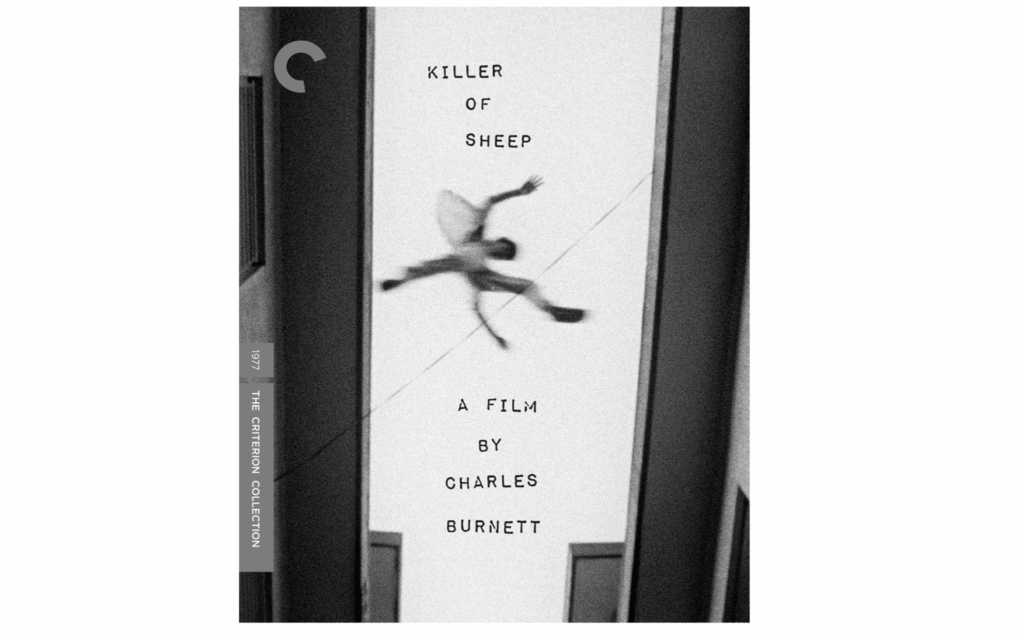
There’s a particular pleasure in seeing a scrappy, half-forgotten masterpiece like Killer of Sheep reborn in the crystalline light of 4K restoration through the Criterion Collection. It feels a little like watching a beloved old family photo get dusted off, straightened, and, miraculously, colored in, without losing the smudges and creases that made it precious in the first place. Charles Burnett’s grainy, intimate portrait of Watts, originally cobbled together as a grad-school thesis, has now been given the Criterion polish. The result: a film that was always haunting suddenly glows.
The leap in clarity is substantial. Earlier releases, noble though they were, bore the indignities of standard definition, the kind of fuzziness that makes you squint and mutter, “Well, it’s important historically.” Now, with richer grayscale and consistent textures, you actually notice things, creases in Stan’s brow, the way kids’ shoes scuff against asphalt, the tender architecture of shadows. Of course, because Burnett shot on 16mm and later blew it up to 35mm, it will never be “razor sharp.” Some frames are still soft around the edges, like the memory of a dream. But that feels right; Burnett never set out to be Kubrick.
The soundtrack gets a comparable upgrade, most notably with the reinstatement of Dinah Washington’s “Unforgettable” over the final scene, a needle drop that had been lost to the thorny jungle of music rights. (Imagine cutting The Graduate without “The Sound of Silence.”) Criterion’s restoration of that moment is the kind of gesture that makes film nerds weep into their Blu-ray shelves, a reminder of why this company remains cinema’s most reliable custodian.
As far as bonus features go, not everything made the cut. Burnett’s follow-up feature, My Brother’s Wedding, which accompanied earlier editions, is absent here, presumably to be saved for a future spine number. Think of it as Criterion’s version of playing hard-to-get. In its place, though, are riches: Burnett’s early shorts Several Friends (a sketchbook for Killer of Sheep) and The Horse (stranger, thornier, introduced by Burnett himself, perhaps to vouch for its eccentricities). There’s also Robert Townsend’s documentary A Walk with Charles Burnett; a heartfelt, twenty-minute homage from Moonlight director Barry Jenkins, whose reverence practically vibrates off the screen; and an impressive heap of interviews, oral histories, and cast reunions. The commentary track with Burnett and Richard Peña, imported from the Milestone release, remains a masterclass in how to cram an encyclopedia’s worth of context into eighty lean minutes.
The accompanying booklet, with a graceful essay by Danielle Amir Jackson, doesn’t just situate Killer of Sheep within the L.A. Rebellion but gently reminds you that Burnett’s quiet humanism has influenced nearly every Black filmmaker since. Watching Stan trudge home from the slaughterhouse now, restored to the shimmer and gloom Burnett intended, feels less like stepping into a film than into a hymn.
Criterion has done it again. They’ve taken a film that was once a whispered legend among cinephiles and made it not just visible, but radiant. If Killer of Sheep was always about finding poetry in the everyday, this new release finds poetry in the act of preservation itself.