Robert Bresson, that famously ascetic French director who could make a man opening a door feel like a moral crossroads, remains one of cinema’s most quietly disruptive forces. His peers have spent decades genuflecting before him. Jean-Luc Godard, never one to toss off a compliment without at least three layers of irony, once proclaimed, “Robert Bresson is French cinema, as Dostoevsky is the Russian novel and Mozart is German music.” This was Godard’s way of saying, “We are all merely renting space in the house Bresson built.” And while cinephiles have long debated whether he was greater than Jean Renoir, most of them eventually surrender and admit, in a whisper, “Well… maybe.”
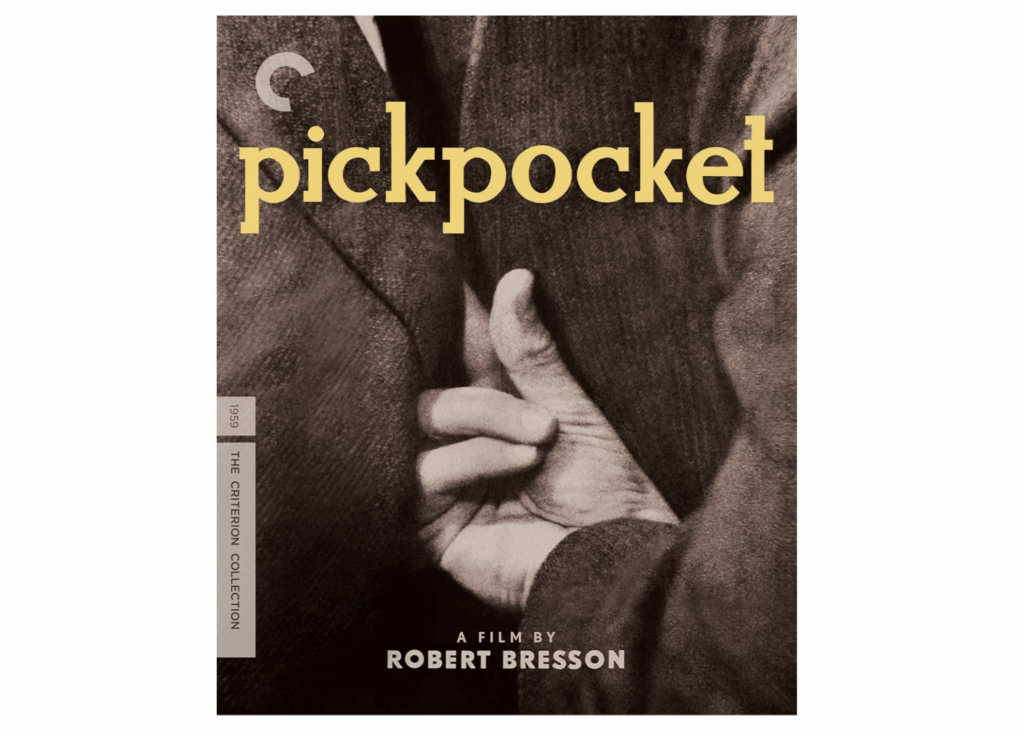
Bresson was a man allergic to frills, whether it be cinematic, emotional, decorative, or otherwise. So when, in 1959, he wrote his first original screenplay (rather than raiding the sacred shelves of French literature), he titled it with the sort of unapologetic literalism only Bresson could make chic. Enter Pickpocket. Comparisons to Dostoevsky’s Crime and Punishment arrived immediately, probably because any French film involving crime, guilt, and a vaguely tormented man inevitably gets accused of Dostoevskyism. Still, Bresson’s spiritual fingerprints, which are clean, spare, and a little judgmental, are all over the thing.
Enter Martin LaSalle, in one of those early-career roles that feels like it’s watching you. He plays Michel, a young man who wants to be a writer but settles for recreational larceny. Michel doesn’t just steal to survive, he steals because it gives him the kind of rush most of us only get after three peppermint mochas and a self-destructive text message. His first venture is snatching wallets at a racetrack that ends with a mild scolding from the police, the bureaucratic equivalent of, “Son, please don’t Pickpocket in front of so many witnesses.”
Soon he meets a seasoned thief on a bus, and the two bond instantly, as though they’ve swiped each other’s hearts from a buttoned inner pocket. A third thief eventually joins their misfit band, and the trio forms a kind of moral anti–Musketeer unit. Their scenes together, sleight-of-hand choreography set to an invisible metronome, are some of the film’s most hypnotic moments. It’s as if Bresson whispered to his cinematographer, “Let’s make petty crime look like ballet.”
But life has a way of interrupting even the most promising criminal apprenticeships. Michel’s mother falls gravely ill, cared for by the luminous Jeanne (Marika Green), who seems constitutionally incapable of judging him, which only makes his moral waffling more pronounced. He brings money but no emotional presence. Whether this is cowardice, compulsion, or Bressonian design is left, with typical austerity, entirely to us. Bresson trusted his audience, sometimes more than they trusted themselves.
When Michel’s partners in crime are arrested, he gallivants across Europe, stealing with impressive efficiency and then wasting his earnings on decadent amusements, proving that spiritual malaise travels surprisingly well. After two years of cosmopolitan misbehaving, he returns home to see if redemption will still have him.
As usual with Bresson, the actors, mostly unknowns, function less like performers and more like human tuning forks, vibrating with muted interior conflict. Dialogue is sparse, used only when absolutely necessary, like a family that communicates exclusively through raised eyebrows at Thanksgiving dinner. The real storytelling happens in glances, hand movements, and that signature Bresson pause that feels like the universe taking a breath, which continues to stun modern audiences even in 2025.
PURCHASE THE CRITERION BLU-RAY HERE
The Criterion Collection’s restoration of Pickpocket is, fittingly, immaculate. Presented in 1080p and carefully supervised in Paris by Mylène Bresson, the transfer ditches the debris and scratches of past editions, revealing an image so crisp you can practically feel the fabric of Michel’s increasingly guilt-ridden overcoat. Blacks are rich, whites are clean, and the grayscale is a graduate seminar in French existentialism. The audio, a French LPCM 1.0 track, remains faithful to Bresson’s famously minimalist sound design. While part of me longs for an indulgent 5.1 mix, just imagine the surround-sound intimacy of rustling wallets. The original mono is clean, balanced, and free of the aural pops that plague many films of its era. It’s restrained, yes, but then again, so was Bresson, this is a man who probably whispered even when alone.
Criterion, in its usual saintly thoroughness, piles on the supplements: a commentary from TIFF’s James Quandt, a Paul Schrader introduction (Schrader being the world’s leading expert in cinematic spiritual agony), a documentary with the cast, archival TV appearances, a Q&A, hand-magic demonstrations from Kassagi, the film’s sleight-of-hand consultant, and a lovely booklet featuring an essay by Gary Indiana.
In short, Pickpocket is still a marvel. It’s lean, haunting, morally ambivalent, and spiritually charged. It’s a film about a man making all the wrong choices until he stumbles, almost by accident, onto the right one. And thanks to Criterion’s reverent restoration, it has never looked better. Highly recommended. Especially if you’ve ever wondered whether redemption is possible, even after you’ve stolen everything but the audience’s sympathy.