There are directors, and then there are auteurs with dollhouses. Wes Anderson belongs, quite happily, to the latter category. He’s a meticulous curator of whimsy whose films look less like they were shot than arranged, dusted, and symmetrically aligned by an especially fastidious museum docent. Over the years, he has proven himself to be among the most visually distinctive filmmakers working, a man whose stories do not merely unfold within their environments but seem to have been born from the wallpaper, the drapery, and the precisely labeled file cabinets therein. His worlds resemble our own only in the way a storybook resembles history. It’s familiar, yes, but with better lighting and more charming neuroses.
What’s most peculiar, bordering on suspicious, is that Anderson’s films have not suffered the usual erosion of time. One expects, as with so many directors, a gradual decline. The early brilliance giving way to late-career indulgence, and the cinematic equivalent of a once-great chef now phoning in the soufflé. I could offer examples, but you likely already have a mental list, complete with sighs. Anderson, however, has dodged this fate with the elegance of one of his own tracking shots. His films continue to arrive with their signature blend of deadpan comedy, emotional precision, and visual fastidiousness intact, each one a carefully wrapped package that, upon opening, reveals yet another smaller, equally delightful package inside.
Which brings us, naturally, to The Fantastic Mr. Fox, the slender, mischievous tale by Roald Dahl that seems, in retrospect, less like source material and more like destiny. In adapting it, Anderson found a playground perfectly suited to his sensibilities. It’s a pastoral caper populated by cunning animals, tyrannical farmers, and an abiding appreciation for corduroy. The result is a stop-motion film that feels both handmade and immaculately designed, like a child’s diorama assembled by an adult with very strong opinions about color palettes.
At the center is Mr. Fox, voiced with unflappable suavity by George Clooney, who imbues the character with a kind of rakish confidence that suggests he could narrate a heist or sell you a very expensive espresso machine. Having traded in his life of poultry theft for a respectable career in journalism (a choice that feels like its own quiet joke), Mr. Fox settles into domesticity with his wife, Felicity, which is given warm, wry life by Meryl Streep, and their son Ash (Jason Schwartzman). But, as with many reformed scoundrels, the call of one last job proves irresistible.
The job, in this case, involves liberating chickens, cider, and general dignity from the gloriously named farmers Boggis, Bunce, and Bean, who are rendered with appropriate menace by Michael Gambon. Alongside a twitchy but loyal opossum (voiced by Wallace Wolodarsky) and against the cautious counsel of a lawyerly badger (a delightfully dry Bill Murray), Mr. Fox hatches a plan that is equal parts ingenious and catastrophically irresponsible. Meanwhile, familial tensions simmer, particularly with the arrival of the improbably competent cousin Kristofferson (Eric Chase Anderson), whose very existence feels like an affront to adolescent insecurity.
What makes Mr. Fox “fantastic,” in the end, is not merely his cunning but his composure. Even as his schemes spiral into chaos with floods, rabid dogs, and existential burrows included, he maintains a curious calm, a belief that things will, somehow, resolve themselves. It is a confidence that borders on delusion but lands, thanks to Clooney’s performance, as something like grace.
Anderson, for his part, remains faithful to Dahl’s spirit while layering in his own signature touches with dialogue that snaps with dry wit, visual gags that reward the attentive, and a peculiar insistence on characters “cussing” rather than cursingm which is a joke that never quite wears out its welcome. The humor operates on multiple frequencies. Children delight in the kinetic absurdity, while adults recognize the quiet satire and the existential undercurrent humming beneath the corduroy.
Visually, the film is a marvel of tactility. The stop-motion animation does not strive for seamless illusion so much as it revels in its own artifice. You see the fur ripple, the fabrics crease, the tiny stitches in miniature costumes, details that lend the film a richness often absent from slicker, digital fare. Every set feels lived-in, every prop considered, as though an entire civilization of very stylish woodland creatures exists just offscreen, waiting for their cue.
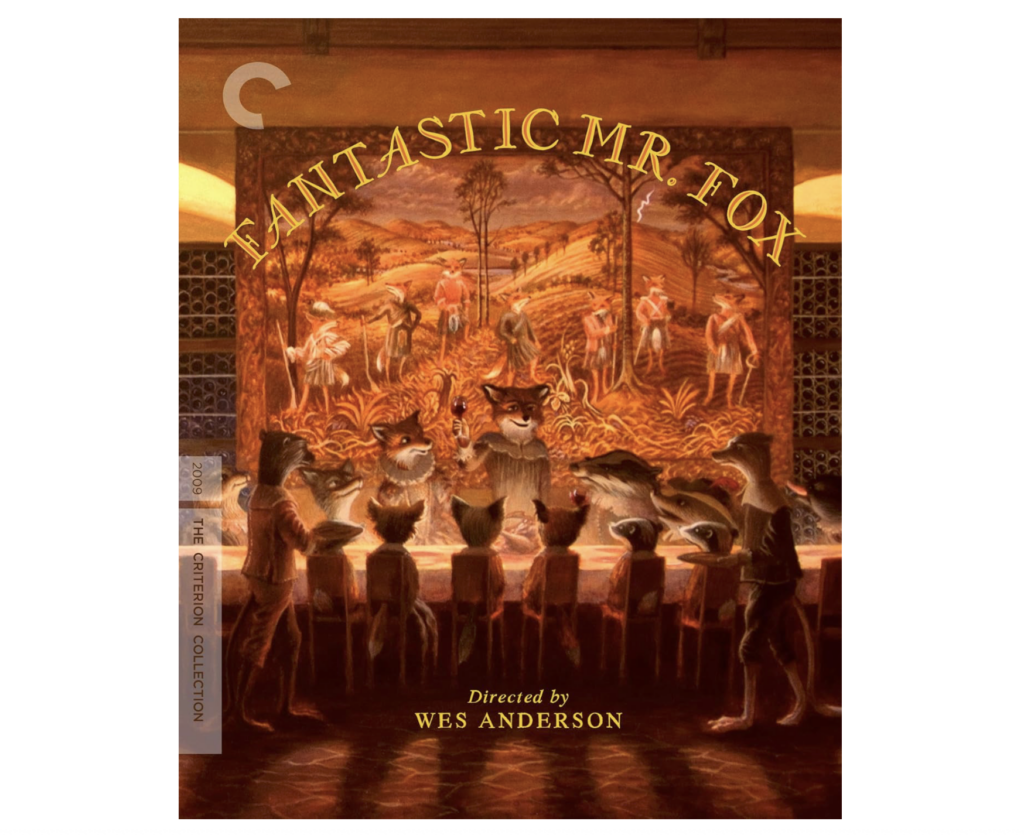
PURCHASE THE BLU-RAY HERE
The Criterion release, supervised by Anderson himself, renders all of this with astonishing clarity. The image is so sharp you can practically count the individual hairs on Mr. Fox’s head, which is more than can be said for many live-action performances. The color palette has those warm autumnal browns and yellows, punctuated by bursts of red and blue, glows with storybook vibrancy, while the depth of the sets invites you to peer into every meticulously constructed corner.
The audio, too, is a small triumph: a crisp, immersive mix that captures everything from the rustle of leaves to the delicate crunch of stolen poultry. The voices are clear, the environments richly textured, and the music is an eclectic, energizing companion, but never overwhelms. It is, in short, the sort of presentation that makes one briefly consider reorganizing one’s entire living room around a television.
The extras, as is the Criterion way, are abundant and oddly fascinating. Anderson’s commentary is a particular pleasure, full of anecdote and influence, at one point invoking Magnum, P.I., which feels both unexpected and entirely correct. There are making-of features that reveal actors digging holes on actual farms (method acting, but for rodents), animatics, archival recordings of Dahl, and enough behind-the-scenes material to make you appreciate just how much labor goes into making something appear so effortlessly whimsical.
In the end, The Fantastic Mr. Fox is not merely an adaptation but a kind of artistic convergence. It’s a meeting of Dahl’s mischievous imagination and Anderson’s meticulous sensibility. It is a film that invites repeat viewings, not out of obligation but out of genuine pleasure, each revisit offering some new detail, some small delight previously overlooked. Criterion, unsurprisingly, has done it again. And Anderson, just as unsurprisingly, remains very much himself, still arranging his dollhouse, still inviting us inside.