Happy Days: Season 5 – Episode 18 “Richie Almost Dies”
For a show that wore its optimism as comfortably as a letterman jacket, Happy Days rarely trafficked in despair. Its Milwaukee was a place where jukeboxes cooperated, parents were patient, and even the most serious problems could be resolved in the time it took to share a milkshake. Which is why, when the series briefly slipped off its sunny axis, it felt less like a plot twist and more like a small emotional ambush.
At the center of this detour was Arthur “Fonzie” Fonzarelli, The Fonz, the patron saint of effortless cool, as embodied by Henry Winkler. Fonzie didn’t just enter rooms, he improved them. He could fix a jukebox with a well-placed thump, tame a motorcycle like it was a household pet, and make the English language bend around a single syllable with “Ayyyy”, as if it were Shakespearean verse. If adolescence had a dress code, it looked suspiciously like his leather jacket.
But in this particular episode, the myth took a hit. Richie Cunningham, played by a pre-directorial Ron Howard, buys a motorcycle from The Fonz and promptly crashes it, landing himself in a coma. The gang gathers, offering bedside monologues that drift somewhere between earnest confession and sentimental highlight reel. It’s all very moving in the way network television of the era specialized in. It was sincere, tidy, and just a touch manipulative.
And then Fonzie walks in alone.
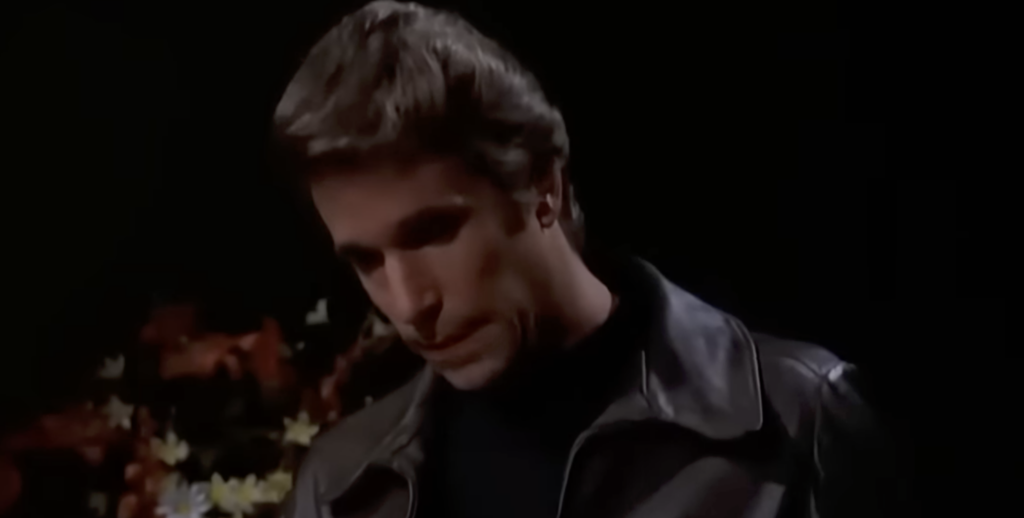
What follows is not tidy. Gone is the swagger, the mechanical magic, and the invulnerability of the coolest guy on the show. In its place is something far more interesting. It shows a young man staring upward, bargaining with God in a voice that doesn’t quite hold together. He asks, no, pleads, for Richie’s recovery, and in doing so, lets his cool fracture into pieces. The tears arrive awkwardly, and almost reluctantly, as if even they understand they are trespassing on sacred territory.
It’s a startling moment, not because television had never depicted grief before, but because it had rarely handed it to someone like Fonzie. Winkler plays the scene without adornment. There is no wink, no cushion of irony, and certainly no shark jumping. It’s just a friend, scared and helpless, discovering that charisma is a poor substitute for control. For a brief minute, the show stops performing happiness and instead examines what happens when it fails.
The scene, as television lore has it, had actual schoolteachers writing and encouraging the writers to let Fonzie cry, so that young viewers might understand that vulnerability and strength are not opposing forces. And yet, whether by design or instinct, the scene accomplishes exactly that. It reframes cool not as the absence of feeling, but as the courage to endure it. It’s a quaintly civic-minded note. It’s the sort of thing that feels almost antique now, like a public-service announcement stitched into primetime. And yet, it works. Perhaps because beneath the leather jacket and the catchphrases, there was always a flicker of something more human waiting to be revealed.
In a series built on good times, it was the bad one that lingered. Happiness, after all, is most convincing when it acknowledges the possibility of its opposite. And for one quietly devastating scene, Happy Days did exactly that.