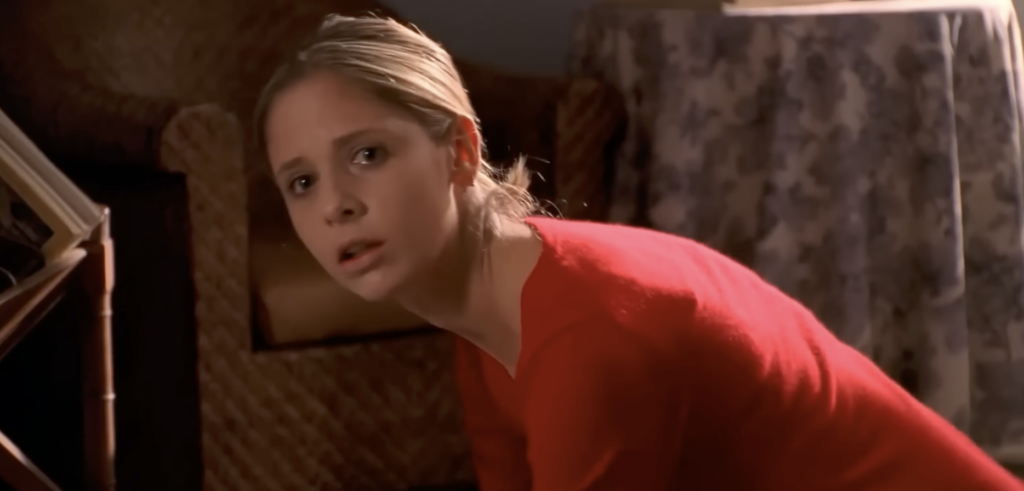
Buffy the Vampire Slayer: Season 5 – Episode 16 “The Body”
There is, at first glance, something faintly unserious about devoting one’s emotional well-being to a television series populated by vampires, demons, and a high-school library that seems to function as a kind of supernatural concierge desk. And yet Buffy the Vampire Slayer, that improbable, genre-defying experiment from Joss Whedon, managed, week after week, to smuggle something achingly human beneath its rubber masks and quippy one-liners. It was, depending on the evening, a horror show, a comedy, a coming-of-age story, a musical, a puppet show, and occasionally a piece of experimental theatre dressed up in network-friendly lighting. It was also, somewhat unfairly, way better than it needed to be.
The premise, as ever, was deceptively simple. Buffy Summers, endowed with preternatural strength and a sense of duty that would make most adults wince, spends her nights dispatching the forces of darkness and her days navigating the more insidious horrors of adolescence. With the help of her friends, each of whom contributes either research skills, emotional ballast, or a well-timed joke, she keeps the world from ending on a fairly regular basis. The show thrived on metaphor, turning teenage anxieties into literal monsters, managing heartbreak with claws, insecurity while casting spells, and death, more often than not, it all came with a dramatic flourish and a convenient opportunity for revenge.
Which is precisely why the episode titled “The Body” lands with such quiet, devastating force. It is an episode that refuses metaphor. There is no demon to blame, no curse to unravel, no narrative trickery to soften the blow. Buffy comes home and finds her mother, Joyce, dead on the couch, which is the result of a sudden brain aneurysm. The scene unfolds with an almost uncomfortable patience. There’s Buffy’s confusion, with her halting attempts at action, the dawning realization that there is nothing, absolutely nothing, to be done. The camera lingers where television usually cuts away. It feels less like storytelling and more like trespassing.
What makes this loss particularly piercing is Kristine Sutherland’s portrayal of Joyce, who, over the course of the series, had become more than a peripheral parental figure. She was the show’s quiet constant, a source of warmth and occasional exasperation, and the sort of mother who grounded the supernatural chaos in something recognizably domestic. Her relationships with the other characters, gentle, amused, sometimes fraught, gave the ensemble a sense of lived-in reality. When she is gone, it is not just Buffy who is unmoored. It is the entire world of the show that seems to tilt slightly off its axis.
Whedon, directing the episode himself, makes a series of choices that feel almost radical in their restraint. Most notably, he eliminates music entirely. In a series that would later burst into song with gleeful abandon, this absence is deafening. There are no swelling strings to cue the audience’s grief, no piano notes to underline a moment of awareness. Instead, there is silence, punctuated by the small, brutal sounds of reality. There are footsteps, breathing, and the dull hum of a refrigerator that has no idea anything has changed. The effect is disorienting, even invasive, as though the episode has stripped away the protective layer that television typically provides.
The supporting characters, each accustomed to facing down literal evil, are rendered helpless in ways that feel almost indecent to witness. There are meltdowns that arrive without warning, anger that searches desperately for a target, and moments of connection that feel less like comfort and more like instinct. A kiss occurs, awkward, urgent, and entirely devoid of romance, suggesting that in the face of death, even intimacy becomes a kind of reflex rather than a choice.
And then there is Anya, whose confrontation with mortality becomes the episode’s emotional centerpiece. Her speech, delivered with a kind of baffled sincerity, circles the most basic and unanswerable questions. Why do people die? Where do they go? Why does everything continue as though nothing has happened? It is a monologue stripped of poetic flourish, almost childlike in its directness, and therefore all the more devastating. In a show that often delighted in cleverness, Anya’s inability to make sense of death feels like the only honest response.
What “The Body” understands, perhaps better than most television before or since, is that grief is not inherently cinematic. It is awkward, uneven, and frequently mundane. It unfolds in waiting rooms and quiet houses, in half-finished sentences and inappropriate thoughts. It does not adhere to narrative structure. It simply resists closure. The episode captures this with an almost unsettling precision, allowing moments to stretch just beyond the point of comfort, as if to remind the viewer that real life rarely edits itself for pacing.
For a series that built its identity on the thrill of survival and the satisfaction of seeing evil named, fought, and ultimately defeated, this episode offers no such reassurance. There is no victory to be won, and no lesson neatly learned. Buffy, who has saved the world more times than seems strictly fair, cannot save her mother. The rules, it turns out, were never rules at all.
And so “The Body” lingers, long after the credits roll, as a kind of quiet rebuttal to everything the show had taught us to expect. It suggests that even in a universe teeming with monsters, the most profound horror is also the most ordinary. It’s the sudden, inexplicable absence of someone who was, until a moment ago, simply there.