Freddy Krueger is the kind of pop culture monster who’d show up uninvited to your nightmares and still somehow charm you before slashing your jugular. Since his 1984 debut in A Nightmare on Elm Street, the “bastard son of a hundred maniacs” has become less an urban legend and more a beloved family member. You know, the one who crashes Thanksgiving dinner with a pun and a blade. Unlike his emotionally unavailable peers Jason Voorhees and Michael Myers, who are both silent, both seemingly allergic to charisma, Freddy talks. He jokes. He flirts with death, then makes you laugh as he kills you. His one-liners are equal parts Shakespeare and dad joke, delivered through a face that looks like someone microwaved beef jerky.
Imagine, if you will, being murdered by a man who looks like a greasy pepperoni pizza with a smoker’s cough and a sense of humor. You’re standing there, moments from becoming human confetti, and he leans in with those razor-fingered gloves gleaming in the moonlight and says, with perfect comic timing, “Welcome to prime time, bitch.” Or, depending on his mood, “How sweet, dark meat.” It’s not just murder. It’s performance art.
These aren’t just one-liners. These are American institutions. The verbal equivalent of the bald eagle or the McRib, simultaneously horrifying and oddly comforting. They should be in the Constitution, or at least printed on the back of every Popeye’s box of extra crispy chicken. Because what Freddy Krueger brought to the table, besides mutilation, was wit and style. He was a killer who killed with panache, and occasionally, a punchline. Freddy didn’t just stab you; he roasted you first. Jason and Michael, bless their masked hearts, had all the personality of malfunctioning Roombas. They stalked, they stabbed, and they sulked like the smelly emo kid in the classroom corner. Freddy, meanwhile, was out here writing material. He was part vaudeville and part sociopath. He was a Catskills comic who just happened to live inside your REM cycle.
And maybe that’s why we love him. Because deep down, every American admires someone who’s great at their job, even if that job is “dream-based serial killer.” Freddy understood timing, pacing, and audience engagement. He didn’t just end lives. He produced them. Every kill was an episode, and every victim a guest star. In another timeline, Freddy would’ve had his own talk show. He’d come out to applause, wave his knife-hand, maybe interview the other monsters. “Please welcome my next guest, Jason Voorhees! Jason, buddy, you’ve gotta talk more. You’re dying up here. Literally.” But here, in our world, we’re left with his cinematic legacy. He’s a slasher who made murder quippy, who looked like a charbroiled stand-up comic, and who reminded us, in his own greasy, terrifying way, that dying is easy, but comedy is hard.
And no one wore the glove better than Robert Englund, who infused the scarred boogeyman with so much vigor and twisted glee that you almost wanted to root for him. Almost. Freddy didn’t just stab people. He turned murder into performance art.
Take, for example, A Nightmare on Elm Street 3: Dream Warriors (1987), a sequel directed, improbably, by the same man who gave us The Blob remake, Eraser, Jim Carrey’s green-faced The Mask, and even The Scorpion King. That’s right. Chuck Russell, the Renaissance man of pulpy chaos. The script? Penned by none other than Wes Craven and Frank Darabont, yes, the future auteur of The Shawshank Redemption once wrote lines for Freddy Krueger. That’s range.
The movie itself is an unholy alliance of teen angst and nightmarish special effects, set in a psychiatric hospital full of the last surviving children of Elm Street’s ill-fated parents. It features a baby-faced Patricia Arquette in her first film, a young Laurence Fishburne as the orderly you wish you had, and Heather Langenkamp returning as the grown-up trauma survivor who’s now doling out therapy.
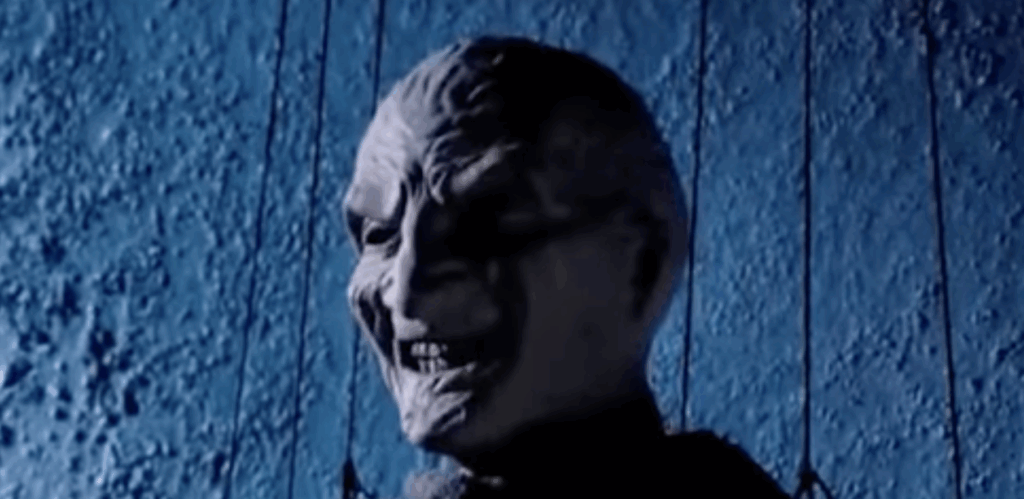
But the scene that’s been lodged in my subconscious since childhood somewhere between my fear of sleep paralysis and my love of stop-motion, is the one where Freddy puppeteers a boy named Phillip (played by Bradley Gregg, better known as Eyeball from Stand By Me). Freddy literally pulls the kid’s veins from his wrists and ankles and uses them as puppet strings. It’s grotesque. It’s genius. Its body horror meets Broadway.
We watch, horrified, as a giant Freddy, part god, part sadistic showman, yanks Phillip up the corridors of the hospital like a nightmarish Geppetto, leading him to the roof and tossing him into the night. The other teens see only a sleepwalker drifting off a ledge, but we, the audience, know better. Freddy’s having the time of his afterlife. It’s the perfect encapsulation of what made Krueger so terrifying and so irresistible. He’s evil with personality. He’s a slasher who knows timing, delivery, and the value of a punchline. Freddy doesn’t just haunt your dreams. He directs them.