It begins, as all great philosophical crises do, with a question. Not “What is the meaning of life?” That one’s been overcooked, but the more deceptively simple “Are you happy?” It’s a question you might expect from a therapist, or perhaps an overly sincere friend who has just returned from a meditation retreat. But in Chronicle of a Summer, Jean Rouch and Edgar Morin’s landmark 1961 documentary, it’s posed to the average Parisian on the street. No therapy couch, no guided breathing, no filter. Just humanity, in all its awkward, beautiful, contradictory glory.
Rouch and Morin were, by design, an odd couple. One was the anthropologist with his head in the tribal rituals of Niger and the other was the sociologist deep in the sociopolitical churn of postwar France. One studied cultures from afar, and the other wanted to diagnose his own. Together, they conceived a social experiment disguised as a film, or perhaps a film disguised as a social experiment. It’s hard to tell which came first. They sent out Marceline Loridan, a Holocaust survivor turned psychologist, to walk the streets of 1960s Paris with a microphone and a disarming question. “Are you happy?” she’d ask. And people, remarkably, answered.
The answers are at once profound and mundane, a collage of postwar ennui, youthful idealism, and that distinctly French cocktail of self-doubt and cigarettes. One young woman talks about love and work. Another confesses she feels trapped by routine. A factory worker grumbles about wages and the government. A student muses about revolution. They talk about Algeria, colonialism, race, Marxism, romance, boredom, and what it means to live a meaningful life in a society that seems increasingly mechanized and absurd.
But Rouch and Morin aren’t content to merely record these slices of life. They turn the camera back on their subjects. After the interviews are filmed, the participants are shown the footage and asked what they think of themselves. It’s one of the earliest cinematic explorations of reflexivity, essentially, people reacting to their own reactions. (Is there a YouTube channel for this?) The results are as uncomfortable as they are illuminating. Some are embarrassed by their own words. Others defend them. A few look like they’re seeing themselves for the first time.
What emerges is a portrait of truth in flux. Happiness, it turns out, isn’t static. It shifts depending on who’s asking, who’s watching, and who’s holding the camera. Rouch and Morin understood this long before social media made self-presentation a national pastime. In a way, Chronicle of a Summer predicted the age of Instagram and podcasts with those performative spaces where we all get to explain ourselves to ourselves.
Yet what keeps the film grounded, and strangely moving, is Loridan. Her quiet persistence, her gentleness, and her haunted grace, all of it colors the film with a rare sincerity. She’s not prying. She’s listening. Having survived Auschwitz, she understands that asking someone how they feel about life isn’t small talk. It’s an act of respect.
Visually, the film is a treasure chest of a bygone Paris. Cobblestone streets, crowded cafés, cigarette smoke curling into the humid air. The camera roams like a lounger, drinking in architecture, faces, and fashion with each frame being a living photograph. There’s something hypnotic about the way Rouch captures the city. Its casual beauty, its melancholy, and its ceaseless hum of thought. Paris becomes not just a backdrop but a character, buzzing with its own anxieties about progress and purpose.
PURCHASE CHRONICLE OF A SUMMER HERE
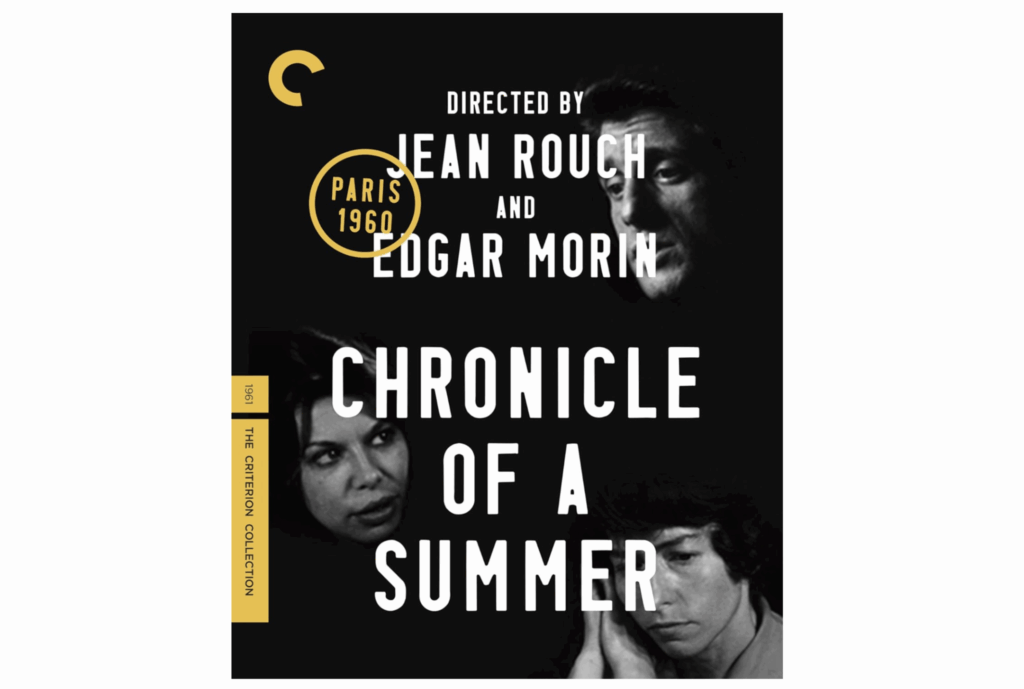
And now, more than sixty years later, Criterion has done what Criterion does best. It’s resurrected the past with surgical precision. This new 2K restoration, presented in 1080p, preserves every grain of 16mm texture like it’s a fine French wine. It’s aged, unfiltered, and perfectly imperfect. The contrast is luminous with deep blacks, glowing whites, and details so sharp you can almost smell the café au lait. It’s the kind of image that makes you want to wear a beret and pretend you understand Derrida.
The mono audio track is crisp, almost startlingly so, with each word and ambient hum preserved in a way that feels freshly recorded. There are no gimmicks here, no artificial surround sound. It’s just honest, unvarnished dialogue. You can hear the air of the city itself.
The extras, as always with Criterion, are delightful. There’s a new documentary on the making of the film, vintage interviews with Rouch and Morin, and the indispensable Criterion booklet that is half essay, half sacred text for cinephiles. It’s like attending a French philosophy seminar from the comfort of your couch.
Of course, Chronicle of a Summer is not the kind of film you watch to be entertained. There are no explosions, no car chases, and no sweeping romance to speak of. It’s not even the kind of movie you “enjoy” in a traditional sense. Watching it is more like reading a great diary you found in an attic or sitting through a long dinner with fascinating strangers which is sometimes tedious, sometimes profound, but always human.
If you’re the type who loves your cinema with a dose of caffeine and contemplation, this is your kind of movie. It’s less about narrative and more about the act of witnessing. It asks you to participate, to listen, to reflect, and to maybe even ask yourself the same question: Am I happy?
When it first premiered, Rouch and Morin’s experiment felt revolutionary, even scandalous. They called it cinéma vérité, “truthful cinema”, but the irony, of course, is that the more the camera tried to capture truth, the more it revealed performance. And that’s the beauty of it. Watching Chronicle of a Summer today feels like looking into a mirror that time forgot. It reminds us that every generation wrestles with the same anxieties, the same yearning for authenticity, and the same hunger for meaning.
So, no, you probably won’t pull this disc off the shelf for a casual rewatch. It’s not Top Gun. It’s not even Amélie. But once you’ve seen it. Once you’ve walked those Parisian streets, eavesdropped on those confessions, and heard that simple question echo through the decades, it sticks with you like an old love letter or a half-remembered dream.
And maybe that’s the point. Chronicle of a Summer isn’t here to entertain you. It’s here to nudge you toward something truer, something quieter. Something like happiness, or at least the search for it.