28 Years Later: Bone Temple is a masterpiece, plain and simple. There’s more soul packed into its decaying bones than in most recent Oscar winners, and by the time the credits roll, you don’t just feel frightened, but you feel seen, a little rattled, and annoyed that so much contemporary horror has been phoning it in and not gone this hard. It’s damn near the best horror film in years, and it has the decency to know it.
I don’t say that lightly. The original 28 Days Later didn’t merely revive the zombie genre. It rewired it. Danny Boyle turned sprinting infected into a cultural mandate, and everyone with a camera and a vague sense of apocalypse promptly copied the homework. Now, nearly three decades later (and yes, the title is doing some heavy emotional lifting), Boyle and original writer Alex Garland have returned with the second chapter of a planned trilogy, however, this time handing the director’s chair to Nia DaCosta, who proves, almost immediately, that she understands the assignment better than most of the genre’s lifers.
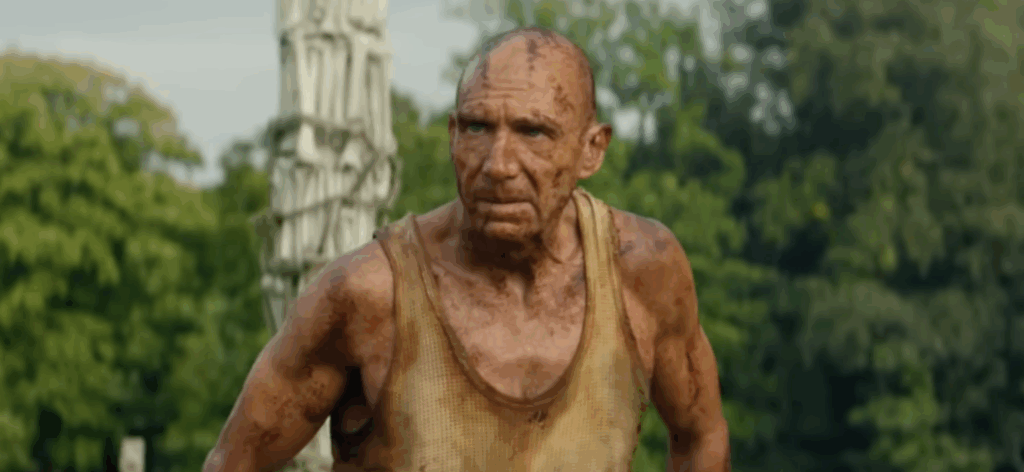
Set moments after the first installment of 28 Years Later, Bone Temple widens the world in fascinating, unnerving ways. We met Spike (Alfie Williams) in the last film, a boy raised to hunt infected by his father (Aaron Taylor-Johnson) for their walled-off village that acted as a coming-of-age story where the family bonding activity is, regrettably, murder. But the film’s true gravitational center is Dr. Ian Kelson, played with haunting restraint by Ralph Fiennes. Kelson was a doctor in the old world and has spent the last twenty-eight years in solitude, building an ossuary, a literal Bone Temple, to honor both the dead and the still-breathing. It’s equal parts memorial, confession booth, and last-ditch act of faith in a world that’s misplaced the concept.
DaCosta, whose résumé hops confidently from Candyman to the MCU to the quietly devastating Hedda, directs this film like someone unafraid of silence, ugliness, or sincerity. I’ll admit my guard was up without Boyle behind the camera. 28 Weeks Later had its pleasures, but it lacked that first film’s bruised poetry. Here, DaCosta doesn’t just match the franchise’s legacy, but she deepens it. This may well be the strongest entry since the original.
Garland’s script, in DaCosta’s hands, becomes a near-perfect marriage of brutality and tenderness. There is gore, yes, plenty of it, but also moments of startling sweetness and genuinely dark humor. You know, the kind that bubbles up when civilization has not merely collapsed but been actively forgotten. One scene, set to an Iron Maiden track, is already staking its claim as one of the best cinematic sequences of 2026, which is a moment so ferocious and weirdly joyful it feels like the genre is briefly levitating.
The film’s boldest move, though, lies in its quietest relationship in Dr. Kelson’s attempt to communicate with Samson, the massive alpha infected introduced in the previous film. Against all genre logic, and in a way that recalls the recent Planet of the Apes films, it works. These exchanges give the franchise an unexpected heart and push the mythology forward, reframing the infection not merely as a curse, but as something tragically, disturbingly human.
On the other end of the moral spectrum is Sir Lord Jimmy (Jack O’Connell), the leader of a gang of marauders who behave like coked-up ninjas with a philosophy degree from chaos itself. They’re unpredictable, vicious, and terrifying like the Joker, if the Joker had fewer monologues and more knives. The contrast between Jimmy’s nihilism and Kelson’s fragile grace gives the film its thematic spine, which is when everything is lost, do you choose love or obliteration?
By the time the film reaches its epilogue, an expertly calibrated tease for the trilogy’s finale, you can feel Garland and Boyle’s long game snapping into focus. Boyle is expected to return to direct the final installment, but DaCosta has left an indelible mark on this world. She doesn’t flinch from the violence, nor does she sentimentalize survival. Instead, she interrogates the duality of humanity with a steady, unblinking gaze.
28 Years Later: Bone Temple is a rare thing. It’s a horror sequel that expands its universe, deepens its ideas, and still finds time to scare the hell out of you. It’s a perfect film, and it’s going to be very hard to top. See it immediately.