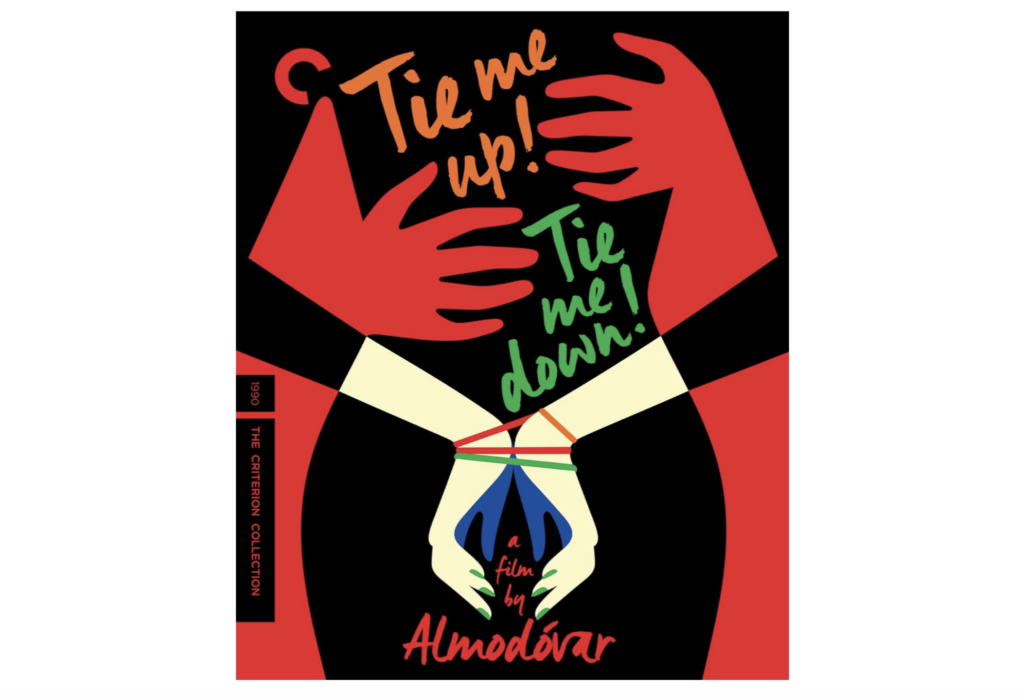
There are, in the long and winding annals of cinematic trivia, certain facts that feel less like information and more like party tricks. You know, tidbits you deploy between sips of a drink, watching them detonate politely across the room. One such fact is that before Antonio Banderas became the swashbuckling feline of family-friendly lore, he was the disquieting heartthrob of a film once stamped with the dreaded X-rating. The movie, Tie Me Up! Tie Me Down!, which is Pedro Almodóvar’s 1990 provocation, and was later recategorized as one of the inaugural recipients of the NC-17 rating, a bureaucratic rebranding that feels, in retrospect, almost quaint.
Almodóvar, of course, has never been in the business of quaint. His films arrive lacquered in bright colors and moral ambiguity, populated by characters who behave badly and feel deeply, often at the same time. In Tie Me Up! Tie Me Down!, he offers a romance that is less meet-cute than meet-crime. Banderas plays Ricky, a recently institutionalized orphan whose plan for a better life involves kidnapping the object of his affection and waiting patiently, and earnestly, for love to bloom under duress.
That object is Marina, played with combustible vulnerability by Victoria Abril, a B-movie actress whose résumé includes adult films and whose present includes a persistent, gnawing loneliness. When Ricky appears at her door, she mistakes him for a fan. It is, in its way, a charming error that is quickly corrected when he forces his way inside, knocks her unconscious, and binds her to the bed with the calm assurance of a man who has rehearsed this moment in his head many times. His pitch, once she wakes, is disarmingly simple: he will take care of her, marry her, and give her children. All she has to do is fall in love. It’s the American Dream, right?
It is a premise that should collapse under the weight of its own perversity. And yet, Almodóvar, through some alchemy of tone, performance, and color, keeps it aloft. Ricky is both a menace and ingenious. He’s a man capable of violence who also fusses over Marina’s comfort, her pain, and her need for stronger medication after his initial, regrettable headbutt. Marina, for her part, moves from terror to something like curiosity, then to a reluctant, disorienting intimacy. The audience follows, not without resistance, but with a growing sense that we are being implicated in something we cannot easily dismiss.
The film’s success hinges, almost indecently, on the chemistry between Banderas and Abril. They do not so much act as orbit one another. Their connection crackles with a strange authenticity that makes even the most implausible emotional turns feel, if not justified, then at least inevitable. It is the kind of pairing that convinces you, briefly and dangerously, that love might indeed be coaxed into existence under the worst possible circumstances.
PURCHASE THE BLU-RAY HERE
Visually, the film is unmistakably Almodóvar: colors bloom and clash, interiors pulse with life, and every frame seems curated to heighten the emotional temperature. The score by Ennio Morricone is lush, with insistent threads through it all, elevating moments that might otherwise tip into absurdity and anchoring them in something closer to sincerity.
Revisiting the film now, particularly in its meticulously restored high-definition release from Criterion, is a reminder of how tactile cinema once felt. The new transfer, sourced from the original 35mm negative and supervised by Almodóvar himself, reveals a startling level of detail: the texture of skin, the glint of sweat, the quiet accumulation of bruises and scars. Colors, always central to Almodóvar’s aesthetic, are rendered with a vibrancy that feels almost aggressive in its clarity. Blacks are deep, shadows hold, and the film grain remains intact, mercifully untouched by the smoothing hand of overzealous digital correction.
The audio, presented in a Spanish DTS-HD 5.1 mix, is similarly attentive. Dialogue is crisp and centered, the score allowed to swell without overwhelming, and ambient sounds drift in and out with a subtlety that suits the film’s intimate scale. It is, if anything, a reminder that this is a talkative film, one driven as much by what is said as by what is done.
The supplemental materials offer their own pleasures. A retrospective documentary gathers Almodóvar, Banderas, and Abril to reflect on the film’s contentious birth and evolving reputation, and a later conversation between director and star provides a more relaxed, almost conspiratorial look back. There are archival curiosities, too, a premiere performance in Madrid, a trailer that now plays like a dare, and a booklet that situates the film within Almodóvar’s broader body of work, as if to reassure us that, yes, this is all part of a larger, coherent vision.
What lingers, though, is the film itself. It’s strange, unsettling, and unexpectedly tender. It is a love story, of sorts, albeit one that arrives bound and gagged, asking you to reconsider the terms under which affection is earned. That it works at all feels like a minor miracle. That it works this well feels, even now, a little dangerous.
And if, in the end, you take a certain impish pleasure in telling your friends that you’ve seen an X-rated Antonio Banderas film, well, that’s just part of the charm.