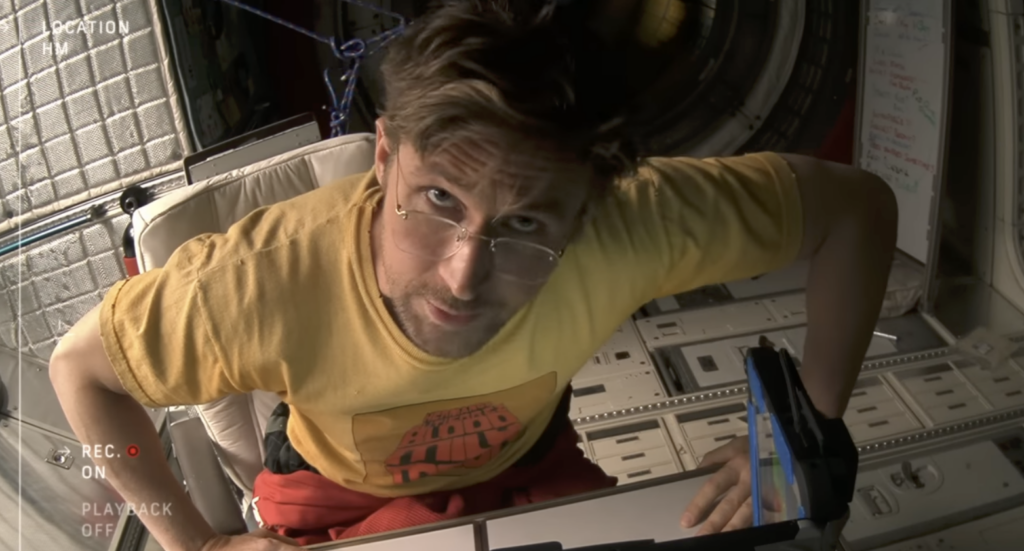
There are actors who seem to specialize in a single emotional register, brooding, say, or quipping, but Ryan Gosling has spent the better part of two decades behaving like a cinematic shapeshifter. He has been a swooning romantic in The Notebook, a taciturn wheelman in Drive, a stuntman with existential problems in The Fall Guy, and, most indelibly, the world’s most existentially confused beach accessory in Barbie. Now, in Project Hail Mary, he adds “middle-school science teacher accidentally tasked with saving the galaxy” to the résumé. One imagines his agent pitching it as The Martian, but with more dad jokes.
The film is based on the 2021 novel by Andy Weir, whose previous cosmic survival yarn became The Martian, the cheerful disaster film directed by Ridley Scott in which Matt Damon farmed potatoes on Mars while cracking wise. That movie had the air of a high-stakes science experiment conducted by adults. Project Hail Mary, directed by the reliably playful duo Phil Lord and Christopher Miller, the mischief-makers behind 21 Jump Street and The LEGO Movie, feels less like a lab and more like a particularly enthusiastic middle-school science fair.
The premise is apocalyptic but oddly sunny. Earth’s sun is dying, which tends to put a damper on long-term vacation plans for humanity. A desperate international effort sends a small spacecraft toward a distant star system in hopes of solving the problem. When Gosling’s Dr. Ryland Grace wakes from hypersleep, he discovers two things. He is alone, and the rest of the crew has died. The third discovery is more existential. He isn’t even really an astronaut. Grace is a middle-school teacher who once floated a theory about solar behavior and was subsequently drafted into a mission that feels less like NASA protocol and more like a cosmic group project gone terribly wrong.
Under most directors, this might become a sweaty survival thriller. But Lord and Miller have a gift for turning existential dread into a gently absurd comedy, and Gosling, who has perfected the art of playing a handsome man slightly baffled by the universe, leans into it with a kind of golden-retriever charm. The end of the world, in this telling, is less grim than awkward.
Then the movie reveals its most curious twist. Grace encounters another spacecraft. Inside is an alien, eventually nicknamed Rocky, who resembles, roughly, a spider assembled out of granite and mystery. Rocky, too, is the sole survivor of a mission to save his own planet from the same cosmic affliction. What follows is essentially an interstellar buddy comedy, in which two lonely scientists attempt to communicate across biology, physics, and a rather steep language barrier.
And here the film finds its sweet spot. The friendship between Grace and Rocky, built through improvised science experiments and the universal language of problem-solving, is genuinely delightful. Watching the two of them learn to trust one another has the gentle emotional rhythm of a children’s book about unlikely pals. At times, one half-expects them to start a podcast.
But the film’s greatest strength is also its mildest weakness. Project Hail Mary is relentlessly cute. It wants very badly to tug at the heartstrings, sometimes with the subtlety of a kindergarten play about friendship. Steven Spielberg managed a similar emotional alchemy with E.T. the Extra-Terrestrial, but there the sentiment felt mysterious and earned. Here, it occasionally feels like the movie is nudging you in the ribs and saying, “Feel this now.“
The script, by Drew Goddard, whose credits include Cloverfield and The Cabin in the Woods, splits its time between Grace’s present-day interstellar problem-solving and flashbacks to Earth, where various scientists attempt to stop the sun from politely ending civilization. The result is a film that feels like three separate movies stitched together. One is a space survival tale, the others are a scientific procedural, and a surprisingly wholesome alien friendship saga.
At 136 minutes, it also ends several times. The movie arrives at what appears to be a conclusion, pauses, wanders off for another emotional epilogue, and then returns yet again, like a dinner guest who keeps remembering one more story at the door.
The visual effects, meanwhile, are perfectly competent and almost entirely forgettable. Much of the film exists in that glossy digital nowhere familiar to modern blockbusters, with vast chambers of green screen that look impressive but leave little behind in the imagination. One is tempted to note that space felt more tactile in 1968’s 2001: A Space Odyssey.
Still, Gosling remains the film’s gravitational center, even when the character itself strains credibility. We are asked to believe that Dr. Grace is a lonely shut-in with no romantic life, no close friends, and little social presence beyond teaching middle-school science. This is mildly difficult to accept when the man in question is played by Ryan Gosling, who looks less like a reclusive teacher and more like a surf instructor who wandered into a NASA orientation by accident.
In the end, Project Hail Mary doesn’t quite stick the landing, though it tries valiantly. Several times. What it delivers instead is something gentler. It’s a warm, slightly corny space adventure about cooperation, curiosity, and the strange comfort of finding a friend in the vastness of the universe.
It may not save the sun, but it will probably entertain the kids on the ride home from the theater.