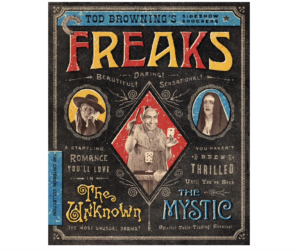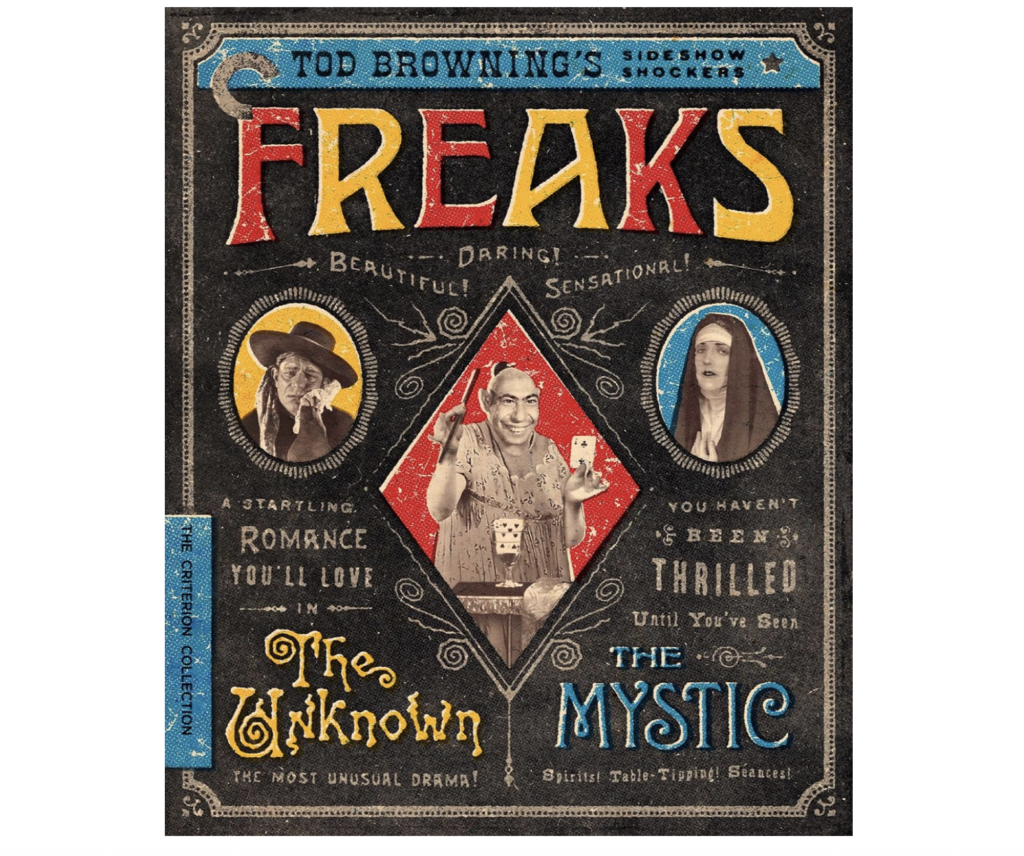
There is a particular pleasure that’s rare, and almost illicit, in watching something survive its own century and come back looking better than you remembered yourself at twenty-five. Not preserved, exactly, but revived. Polished just enough to remind you that time has not dulled its edge, only sharpened your ability to notice it. That is the peculiar thrill of Tod Browning’s Sideshow Shockers, a Criterion box set that gathers three of Tod Browning’s most enduring, and enduringly strange works: Freaks, The Unknown, and The Mystic.
What emerges, over the course of these films and their meticulous restorations, is not simply a portrait of a filmmaker, but of a sensibility so committed to the margins that it begins to feel like a worldview. Browning did not so much tell stories as wander into the corners polite society preferred to ignore and turn on a very bright light.
It is, of course, Freaks that arrives with the loudest reputation, dragging behind it decades of controversy, academic essays, and the kind of whispered myth-making usually reserved for cursed objects. The film has been called exploitative so often that the accusation has calcified into a kind of reflex. And yet, seeing it now, particularly in this luminous restoration, you begin to suspect that the discomfort says more about the audience than the film. Browning’s camera does not leer so much as linger. It observes. It sits with its subjects, many of them real sideshow performers, with a patience that feels almost radical.
What’s startling is how quickly the film reorients your sympathies. The so-called “freaks” are not spectacles but rather a community. They flirt, they bicker, they celebrate, and they fall in love with a sincerity that feels almost disarming. The true grotesquerie arrives, as it so often does, in the form of conventionally beautiful people behaving very badly. When the betrayal comes, and it does, with a kind of operatic inevitability, the film pivots from curiosity to nightmare. The famous chant, “Gooble gobble, one of us,” lands not as camp but as something closer to ritual, an incantation that collapses the distance between inclusion and entrapment.
Browning’s genius lies in his refusal to provide the audience with a safe vantage point. There is no comfortable perch from which to observe. The horror does not come from a supernatural intrusion but from a moral inversion. It’s the realization that monstrosity is not a matter of form but of action. It’s a lesson that continues to echo through modern horror, where one can see its fingerprints in the carefully constructed dread of Ari Aster’s Hereditary, but rarely with such unnerving directness.
If Freaks is Browning’s thunderclap, The Unknown is his slow burn, a film that coils around you with the quiet confidence of a magician who knows exactly when you’re going to blink. Featuring the protean Lon Chaney, a man who seemed less like an actor than a shape-shifter, and a young Joan Crawford still in the process of becoming Joan Crawford, the film begins as something like a romance and ends as something closer to a psychological autopsy.
Chaney’s Alonzo, a knife-thrower who pretends to have no arms, is one of Browning’s most perversely compelling creations. His deception is practical at first, a means of evading the law, but it metastasizes into something far more unsettling when it becomes entangled with desire. Alonzo’s love for Crawford’s Zanzi, who recoils from physical touch, is less a romance than a perfect storm of neuroses. Here, Browning seems almost prescient, diagnosing a culture that would one day turn obsession into spectacle and intimacy into performance.
The film’s twists are sharp, surprising, and delivered with a kind of offhand cruelty that feels decades ahead of their time. One is tempted to draw a line from Browning to modern purveyors of narrative sleight-of-hand, though it’s hard to imagine even the most twist-happy contemporary filmmaker matching the film’s final, devastating turn. What lingers is not the shock but the sadness. It’s the sense that these characters were never going to escape the roles they had written for themselves.
Then there is The Mystic, perhaps the least discussed of the trio and, in this context, the most quietly revelatory. If Freaks interrogates the body and The Unknown dissects the psyche, The Mystic turns its attention to belief, and how it’s constructed, how it’s sold, and how easily it can be manipulated. The film plays like a séance conducted with a wink, where its narrative is built around con artists who exploit grief by offering theatrical glimpses of the afterlife.
It’s difficult not to see its influence rippling outward, particularly in the lineage that leads to Nightmare Alley and, eventually, to Guillermo del Toro’s more recent interpretation. Browning understands, perhaps better than anyone, that illusion is not merely about deception, but rather, it’s about desire. People want to believe, and that wanting is where the real drama lies. The film’s tension comes not from whether the con will succeed, but from what it reveals about the people who fall for it, and the people who perpetrate it.
PURCHASE THIS CRITERION SET HERE
All of this would be reason enough to revisit these films, but Criterion, The Criterion Collection, the patron saint of cinematic resurrection, has gone several steps further. The restorations themselves are nothing short of astonishing. Freaks, assembled from multiple 35mm sources and scanned at 5K, looks almost implausibly vivid. Details once lost to time with subtle gestures and fleeting expressions now emerge with startling clarity, giving the film a newfound immediacy.
The Unknown, pieced together from disparate prints, wears its restoration more visibly. The image shifts, flickers, occasionally betrays its patchwork origins. And yet, there is something oddly fitting about this. The film, after all, is about fragmentation, of identity, desire, and its visual instability becomes part of its texture, a reminder of the fragile conditions under which these works have survived.
The Mystic may be the greatest beneficiary of the restoration process. Sourced from a 35mm element and scanned at 2K, it boasts a stability and depth that allow Browning’s compositions to fully breathe. The shadows feel deeper, the faces more sculptural, the illusions more convincing. It is, in many ways, the most modern-looking of the three, a film that seems to have been waiting patiently for the technology to catch up to it.
The audio, too, is handled with a kind of reverence that avoids the trap of overcorrection. New scores, most notably by Philip Carli and Dean Hurley, complement rather than compete, adding texture without imposing interpretation. They understand that silence, in these films, is not absence but presence in a space in which the audience is invited to lean in, to participate.
And then there are the extras, which arrive not as afterthoughts but as extensions of the films themselves. Commentaries by historians like David Skal, documentaries, alternate endings, and even readings of the original, more grotesque source material for Freaks create a kind of dialogue across time. One begins to see Browning not as an outlier but as a figure in conversation, with his contemporaries, with his critics, and now, with us.
What’s most striking, perhaps, is how contemporary all of this feels. In an era preoccupied with representation, authenticity, and the ethics of storytelling, Browning’s work refuses easy categorization. It is empathetic without being sentimental, provocative without being cynical. It asks uncomfortable questions and declines to answer them neatly.
A century later, these films do not feel like artifacts so much as challenges. They dare you to look, and then to keep looking, even when the act of looking becomes complicated. Especially then.
“MUST-OWN,” as the marketing language would have it, feels almost insufficient, too transactional for something that operates on this level. This set is less a purchase than a confrontation, a beautifully restored invitation to step into Browning’s world and see what, exactly, you bring with you. One suspects the answer may not be entirely flattering. Which, of course, is precisely the point.