There’s a certain irony in the fact that horror films featuring wild animals can feel more terrifying than those populated by actual monsters. Vampires, werewolves, demonic dolls, at least they’re fantastical, stitched together from folklore and nightmares. They’re scary, yes, but there’s comfort in the absurdity. You don’t expect to run into Freddy Krueger in the produce aisle at Trader Joe’s. A chimpanzee, on the other hand? You’ve seen one. Maybe you’ve even tossed it peanuts at the zoo, or watched grainy YouTube videos of them wearing diapers and drinking Capri Suns. And yet, one wrong tilt of the head, one flash of teeth, and you realize you’re staring into the uncanny valley, your own DNA staring back at you with no capacity for mercy.
That, in essence, is what Johannes Roberts is banking on with Primate, his new horror opus that manages to be both gleefully ridiculous and genuinely frightening. Roberts, who previously dunked Mandy Moore into shark-infested waters in 47 Meters Down, understands that what really unsettles audiences isn’t the outlandish, it’s the everyday turned inside out. And what’s more everyday than the bond between humans and their pets? Only here, the pet is a chimpanzee, and instead of playing dress-up or starring in a tea party, it contracts rabies and takes an entire household hostage.
If Jaws convinced a generation of beachgoers to avoid the water, Primate might make you eye your cousin’s Labradoodle with fresh suspicion. The premise is almost comically direct. Troy Kotsur, fresh off his Oscar win, plays a father who leaves his two daughters (Johnny Sequoyah and Gia Hunter) alone with their clever and affectionate chimp while he embarks on a book tour in Hawaii. The family’s cliffside home is pure aspirational cinema, floor-to-ceiling windows, the kind of infinity pool that makes you mutter “of course they die here.” Within minutes, Roberts establishes his tone. The chimp, sweet one second, snaps the next. The first act ends in blood, and from then on, the film escalates in ways that make you want simultaneously to cover your eyes and peek between your fingers.
Roberts is a student of the horror hall of fame, and you can feel him riffing on the classics. There are echoes of Halloween’s stalking menace, the dream-logic dread of A Nightmare on Elm Street, and yes, even the symmetrical dread of Kubrick’s The Shining. But make no mistake, this is not art-house horror dressed in moody lighting. This is punk rock horror with snarling, loud, and entirely uninterested in subtlety. The violence is not just suggested, it’s displayed with such gusto that the audience audibly groans. Muscles tear, bones snap, faces crumple. Roberts forces us to look, refusing the comfort of the cutaway.
And yet, there’s a streak of dark comedy running through it all. Not in the winking, Marvel-movie quippy sense, but in the absurd juxtaposition of a chimpanzee. A creature we often infantilize as cute, even cuddly, becoming the vehicle for carnage. At moments, you almost laugh at the sheer audacity of it, the way the chimp weaponizes furniture or uses the architecture of the cliffside mansion to stalk its prey. Then, seconds later, you’re jolted back into terror. That’s the sweet spot Roberts seems to be chasing, the uneasy laughter of someone who knows they shouldn’t be laughing at all.
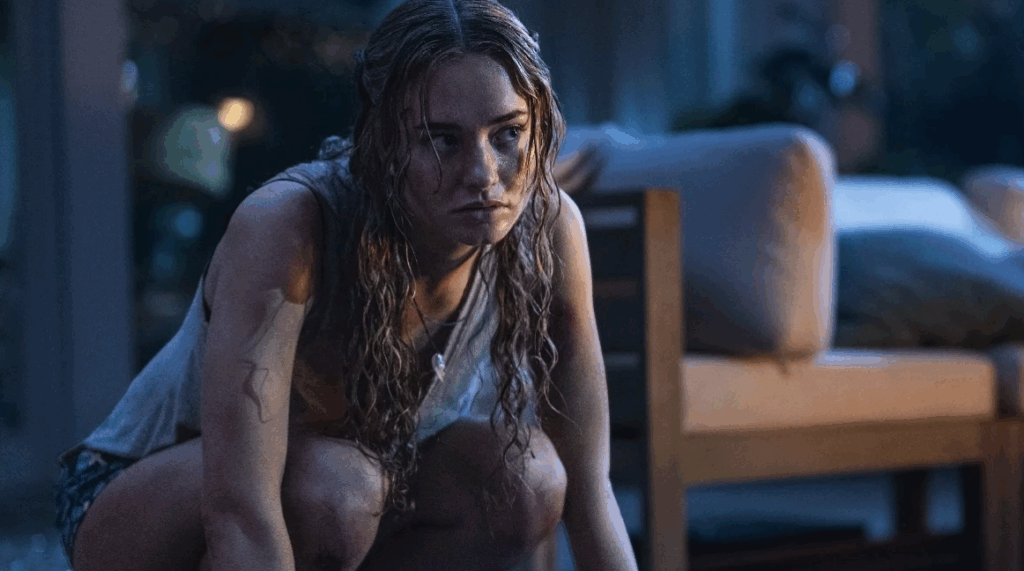
The performances help ground the chaos. Kotsur, with his innate warmth and quiet gravitas, imbues the father with both tenderness and ferocity. When he must fight back, it’s genuinely moving. This isn’t a caricatured action hero, but a dad, terrified and exhausted, doing what he can to save his children. Sequoyah, meanwhile, steps into the “final girl” role with skill, balancing vulnerability with resilience. In another film, her performance might have been overshadowed by the spectacle of violence, but here, she becomes the emotional anchor, a reminder that horror works best when we care who’s being chased.
What’s remarkable is how lean the film is. There are no bloated subplots, no unnecessary mythology about ancient chimpanzee curses or government experiments gone wrong. Roberts keeps it brutally simple. Here’s a house, here’s a family, here’s a rabid chimp. That’s all you need. The simplicity amplifies the dread, allowing the suspense to build in long, quiet moments where you hear the creak of floorboards or the faint scuffle of movement just out of frame. Roberts knows that horror lives in anticipation as much as in execution.
Primate is not subtle, and it doesn’t pretend to be. It’s a B-movie in spirit and an A-movie in execution, gleefully splattering the screen with gore while still understanding the psychology of fear. It checks every horror box. Suspense, blood, dark comedy, and then adds its own feral energy. By the time the credits roll, you’re exhilarated, exhausted, and maybe just a little wary of your next trip to the zoo.
If Jaws kept us out of the water and Cujo made us side-eye the family dog, Primate might leave us glancing uneasily at the nearest primate, real or stuffed, and wondering just how thin the line is between playmate and predator. It’s scary as hell, and, against your better judgment, an absolute blast.